Question

The angle of incidence at which reflected light is totally polarized for reflection from air to glass (refraction index n) is

(a)

(b)

(c)

(d)

Answer

(d)

Need a full question paper?

Generate a complete, print-ready paper with questions like this in minutes — across 16+ boards, with answer keys.

Start Generating Free

Similar questions

Cathode rays are

(a) Positive rays

(b) Neutral rays

(c) He rays

(d) Electron waves

In a nuclear reactor, moderators slow down the neutrons which come out in a fission process. The moderator used have light nuclei. Heavy nuclei will not serve the purpose because:

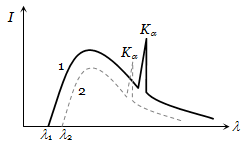
The intensity distribution of X-rays from two coolidge tubes operated on different voltages V1 and V2 and using different target materials of atomic numbers Z1 and Z2 is shown in the figure. Which one of the following inequalities is true?

(a) V1 > V2, Z1 < Z2

(b) V1 > V2, Z1 > Z2

(c) V1 < V2, Z1 > Z2

(d) V1 = V2, Z1 < Z2

If a resistance  is connected in parallel with the resistance R in the circuit shown, then possible value of current through R and the possible value of   will be

(a)  

(b) I, 2R

(c)  

(d)  

The a-particle is the nucleus of an atom of

(a) Neon

(b) Hydrogen

(c) Helium

(d) Deuterium

A very high magnetic field is applied to a stationary charge. Then the charge experiences

(a) A force in the direction of magnetic field

(b) A force perpendicular to the magnetic field

(c) A force in an arbitrary direction

(d) No force

Two identical charges q are placed at a distance d from each other. The potential at a point situated at a distance between them will be:

A toroid has number of turns per unit length n, current i, then the magnetic field is

(a)   

(b)  

(c)

(d) None of these

Assertion :   Kinetic energy of photo electrons emitted by a photosensitive surface depends upon the intensity of incident photon.

Reason     : The ejection of electrons from metallic surface is possible with frequency of incident photon below the threshold frequency.

(a) If both assertion and reason are true and the reason is the correct explanation of the assertion.

(b) If both assertion and reason are true but reason is not the correct explanation of the assertion.

(c) If assertion is true but reason is false.

(d) If the assertion and reason both are false.

The magnetic force required to demagnetise the material is: