MCQ
The angle of incidence at which reflected light is totally polarized for reflection from air to glass (refraction index n) is (
  • A
    $\sin ^{-1}( n )$
  • B
    $\sin ^{-1}\left(\frac{1}{n}\right)$
  • C
    $\tan ^{-1}\left(\frac{1}{n}\right)$
  • $\tan ^{-1}( n )$

Answer

Correct option: D.
$\tan ^{-1}( n )$
$\tan ^{-1}( n )$

Need a full question paper?

Generate a complete, print-ready paper with questions like this in minutes — across 16+ boards, with answer keys.
Start Generating Free

Similar questions

The energy of hydrogen atom in its ground state is – 13.6 eV. The energy of the level corresponding to the quantum number n is equal 5 is
When a photon of light collides with a metal surface, number of electrons, (if any) coming out is
A radioactive substance has a half-life of $1$ year. The fraction of this material, that would remain after $5$ years will be
Assertion : Radio waves can be polarised.
Reason : Sound waves in air are longitudinal in nature.
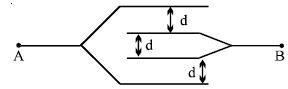
Four metallic plates arearranged as shown in the figure. If the distance between each plate then capacitance of the given system between points $A$ and $B$ is (Given $d < < A$)
One $\text{a.m.u}$ is defined as mass of:
A metal wire of resistance $3\,\Omega $ is elongated to make a uniform wire of double its previous length. The new wire is now bent and the ends joined to make a circle. If two points on this circle make an angle $60^o$ at the centre, the equivalent resistance between these two points will be
The ratio of specific charge of an $\alpha $ -particle to that of a proton is
A TV transmission tower antenna is at a height of $20\, m$. Suppose that the receiving antenna is at.

$(i)$ ground level

$(ii)$ a height of $5 \,m$.

The increase in antenna range in case $(ii)$ relative to case $(i)$ is $n \%$.

The value of $n$, to the nearest integer, is .....$\%$
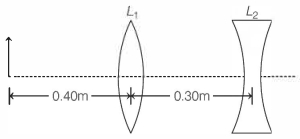
An object is placed $0.40 \,m$ from one of the two lenses $L_1$ and $L_2$ of focal lengths $0.20 \,m$ and $0.10 \,m$ respectively, as depicted in the figure. The separation between the lenses is $0.30 \,m$.The final image formed by these two lenses system is at