MCQ
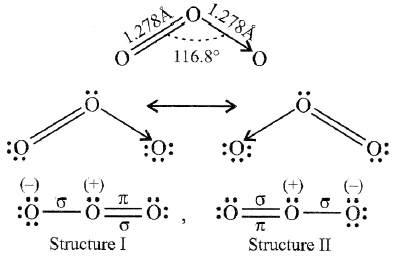
The angular shape of ozone molecule $(O_3)$ consists of
  • A
    $1\sigma$ and $1\pi$ bond
  • $2\sigma$ and $1\pi$ bond
  • C
    $1\sigma$ and $2\pi$ bonds
  • D
    $2\sigma$ and $2\pi$ bonds

Answer

Correct option: B.
$2\sigma$ and $1\pi$ bond
b
In case of single bond, there is only one $\sigma$ -bond, in case of double bond, there is one $\sigma$ and one $\pi$ -bonds while in case of triple bond, there is one $\sigma$ and two $\pi$ -bonds. Thus angular shape of ozone $\left(O_{3}\right)$ contains $2 \sigma$ and $1 \pi$ bond

Need a full question paper?

Generate a complete, print-ready paper with questions like this in minutes — across 16+ boards, with answer keys.

Start Generating Free

Similar questions

The molar heat of formation of $NH_4NO_3(s)$ is $-367.54\, kJ$ and those of $N_2O(g)$ and $H_2O(l)$ are $+ 81.46 \,kJ$ and $-285.78\, kJ$ respectively at $25\,^oC$ and $1.0$ atmospheric pressure. Calculate $\Delta U$ at $25\,^oC$ for the reaction .....$kJ$

$NH_4NO_3(s) \rightarrow N_2O(g) + 2H_2O(l)$

The following reaction is known to occur in the body $C{O_2} + {H_2}O $ $\rightleftharpoons$ $ {H_2}C{O_3} $ $\rightleftharpoons$ $ {H^ + } + HCO_3^ - .$ If $C{O_2}$ escapes from the system
The most appropriate statement regarding organic compounds is
Match List-$I$ with List-$II$
List -$I$ Molecule List - $II$ Shape
$(A)$.  $\mathrm{BrF}_5$ $(I)$.  $T$-shape
$(B)$.  $\mathrm{H}_2 \mathrm{O}$ $(II)$.  See saw
$(C)$.  $\mathrm{ClF}_3$ $(III)$.  Bent
$(D)$.  $\mathrm{SF}_4$ $(IV)$.  Square pyramidal
Angular momentum of an electron in the $n^{th}$ orbit of hydrogen atom is given by
What will be the amount of $MgCl_2$ when $17\,g$ $HCl$ is reacted with excess of $MgO$ in following reaction ............. $\mathrm{g}$

$MgO + 2HCl \longrightarrow MgCl_2 + H_2O$

If there is no rotation of plane polarised light by a compound in a specific solvent, though to be chiral, it may mean that
Which one of the following complexes will have $\Delta_{0}=0$ and $\mu=5.96$ B.M.?
In the reaction $A + 2B$ $\rightleftharpoons$ $2C$, if $2$ moles of $A,\,\,3.0$ $moles$ of $B$ and $2.0$ $moles$ of $C$ are placed in a $2.0\,\,l$ flask and the equilibrium concentration of $C$ is $0.5$ $mole/$$l$. The equilibrium constant $({K_c})$ for the reaction is
$pH$ values of $HCl$ and $NaOH$ solutions each of strength $\frac{N}{{100}}$ will be respectively