MCQ
The antiparticle of electron is:
- APositron.
- B$\alpha - \text{particle}.$
- CProton.
- D$\beta - \text{particle}.$
Generate a complete, print-ready paper with questions like this in minutes — across 16+ boards, with answer keys.
Hydrogen (H), deuterium (D), singly ionized helium ( and doubly ionized lithium (Li) all have one electron around the nucleus. Consider n =2 to n = 1 transition. The wavelengths of emitted radiations are
  and
and  respectively. Then approximately
|
(a) |
(b) 4 |
|
(c) |
(d) |
Assertion : The magnetic filed at the ends of a very long current carrying solenoid is half of that at the center.
Reason : If the solenoid is sufficiently long, the field within it is uniform.
|
(a) If both assertion and reason are true and the reason is the correct explanation of the assertion. |
|
(b) If both assertion and reason are true but reason is not the correct explanation of the assertion. |
|
(c) If assertion is true but reason is false. |
|
(d) If the assertion and reason both are false. |
A radioactive substance has a half-life of 1 year. The fraction of this material, that would remain after 5 years will be
|
(a) |
(b) |
(c) |
(d) |
Equivalent energy of mass equal to 1 a.m.u. is
|
(a) 931 KeV |
(b) 931 eV |
(c) 931 MeV |
(d) 9.31 MeV |
The length of a given cylindrical wire is increased by 100 %. Due to the consequent decrease in diameter the change in the resistance of the wire will be
|
(a) 300 % |
(b) 200 % |
(c) 100 % |
(d) 50 % |
Three long, straight parallel wires carrying current, are arranged as shown in figure. The force experienced by a 25 cm length of wire C is

|
(a) 10-3 N |
(b) 2.5 ×10⁻³ N |
(c) Zero |
(d) 1.5 × 10⁻³ N |
The graph which represents the correct variation of logarithm of activity (log A) versus time, in figure is
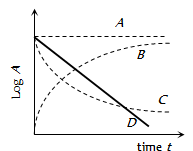
|
(a) A |
(b) B |
(c) C |
(d) D |






