Question
The apparent weight of an object increases in an elevator while accelerating upward. A moongphaliwala sells his moongphali using a beam balance in an elevator. Will he gain more if the elevator is accelerating up?

Answer

No, the accelerating elevator will affect the weight of both sides of the beam balance. So, the net effect of the accelerating elevator cancels out, and we get the actual mass.

Need a full question paper?

Generate a complete, print-ready paper with questions like this in minutes — across 16+ boards, with answer keys.
Start Generating Free

Similar questions

What are the three Newtons Laws of Motion.
From two wires of a metal equal weights are suspended. One of the wire is 2 m long and has diameter of 1 mm and the second has length 1m and diameter 0.5 mm. Find the ratio of increases in length of these.
A source emits 31.4W of radiant flux distributed uniformly in all directions. The luminous efficiency is 60 lumen/ watt. What is the luminous intensity of the source?
In a vessel 80 cm . A gas is filled at the pressure of mercury and at a certain temperature. At the same temperature the mass of the vessel is increased by $60 \%$ by filling more gas in it. Calculate the resultant pressure in the vessel.
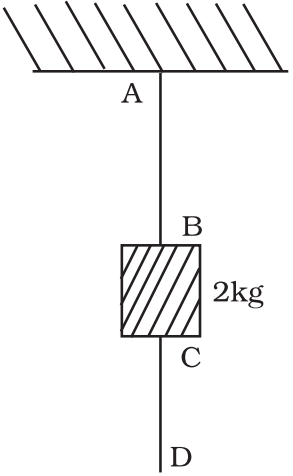
A mass of 2kg is suspended with thread AB Thread CD of the same type is attached to the other end of 2kg mass. Lower thread is pulled gradually, harder and harder in the downward directon so as to apply force on AB. Which of the threads will break and why?
A soap film of thickness 0.0011mm appears dark when seen by the reflected light of wavelength 580nm. What is the index of refraction of the soap solution, if it is known to be between 1.2 and 1.5?
A steel ball initially at a pressure of $1.0 \times 10^5 \mathrm{~Pa}$ is heated from $20^{\circ} \mathrm{C}$ to $120^{\circ} \mathrm{C}$ keeping its volume constant. Find the pressure inside the ball. Coefficient of linear expansion of steel $=12 \times 10^{-6}{ }^{\circ} \mathrm{C}^{-1}$ and bulk modulus of steel $=1.6 \times$ $10^{11} \mathrm{Nm}^{-2}$.
A classroom demonstration of Newton's first law is as follows: A glass is covered with a plastic card and a coin is placed on the card. The card is given a quick strike and the coin falls in the glass.
  1. Should the friction coefficient between the card and the coin be small or large?
  2. Should the coin be light or heavy?
  3. Why does the experiment fail if the card is gently pushed?
Is it necessary to have two waves of equal intensity to study interference pattern? Will there be an effect on clarity if the waves have unequal intensity?
A nucleus is at rest in the laboratory frame of reference. Show that if it disintegrates into two smaller nuclei, the products must be emitted in opposite directions.