MCQ
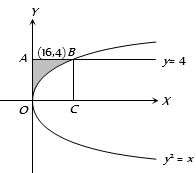
The area bounded by curve ${y^2} = x,$ line $y = 4$ and $y -$ axis is
  • A
    $\frac{{16}}{3}$
  • $\frac{{64}}{3}$
  • C
    $7\sqrt 2 $
  • D
    None of these

Answer

Correct option: B.
$\frac{{64}}{3}$
b
(b) Required area = area of $OABC\, -$ area of $OBC$

$ = 16 \times 4 - \int_0^{16} {\sqrt x } dx = 64 - \left[ {\frac{{{x^{3/2}}}}{{3/2}}} \right]_0^{16} = \frac{{64}}{3}.$
Need a full question paper?

Generate a complete, print-ready paper with questions like this in minutes — across 16+ boards, with answer keys.

Start Generating Free

Similar questions

Let $A B$ be a line segment with mid-point $C$ and $D$ be the mid-point of $A C$. Let $C_1$ be the circle with diameter $A B$ and $C_2$ be the circle with diameter $A C$. Let $E$ be a point on $C_1$ such that $E C$ is perpendicular to $A B$. Let $F$ be a point on $C_2$ such that $D F$ is perpendicular to $A B$ and $E$ and $F$ lie on opposite sides of $A B$. Then, the value of $\sin \angle F E C$ is
The region of the complex plane for which $\left| {\frac{{z - a}}{{z + \overline a }}} \right| = 1\,$ $\,[R(a) \ne 0]$ is
If $72^x \cdot 48^y=6^{x y}$, where $x$ and $y$ are non-zero rational numbers, then $x+y$ equals
The integral $16 \int \limits_1^2 \frac{d x}{x^3\left(x^2+2\right)^2}$ is equal to
If ${z_1},{z_2},{z_3},{z_4}$ are the affixes of four points in the Argand plane and $z$ is the affix of a point such that $|z - {z_1}|\, = \,|z - {z_2}|\, = \,|z - {z_3}|\, = |z - {z_4}|$, then ${z_1},{z_2},{z_3},{z_4}$ are
If $\alpha $ and $\beta $ are imaginary cube roots of unity, then ${\alpha ^4} + {\beta ^4}$ + $\frac{1}{{\alpha \beta }} = $
The function $\mathrm{f}: \mathrm{N}-\{1\} \rightarrow \mathrm{N}$; defined by $\mathrm{f}(\mathrm{n})=$ the highest prime factor of $n$, is :
Let $A =\{ n \in[100,700] \cap N : n$ is neither a multiple of $3$ nor a multiple of 4$\}$. Then the number of elements in $A$ is
The number of symmetric matrices of order $3$, with all the entries from the set $\{0,1,2,3,4,5,6,7,8,9\}$, is :
If $x = cy + bz,\,\,y = az + cx,\,\,z = bx + ay$ (where $x, y, z $ are not all zero) have a solution other than $x = 0$, $y = 0$, $z = 0$ then $a, b$  and $ c $ are connected by the relation