MCQ
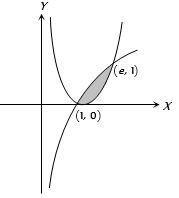
The area bounded by the curves $y = {\log _e}x$ and $y = {({\log _e}x)^2}$ is
  • $3 - e$
  • B
    $e - 3$
  • C
    $\frac{1}{2}(3 - e)$
  • D
    $\frac{1}{2}(e - 3)$

Answer

Correct option: A.
$3 - e$
a
(a) Required area $ = \int_1^e {[\log x - {{(\log x)}^2}]} \,dx$

$A = \int_1^e {\,\log x\,dx} - \int_1^e {{{(\log x)}^2}dx} $

$ = [x\log x - x]\,_1^e - [x{(\log x)^2} - 2x\log x + 2x]\,_1^e$

$ = [e - e - ( - 1)] - [e{(1)^2} - 2e + 2e - (2)]$

$ = (1) - (e - 2)$$ = 3 - e$.
Need a full question paper?

Generate a complete, print-ready paper with questions like this in minutes — across 16+ boards, with answer keys.

Start Generating Free

Similar questions

The value of $\int {{e^{2x}}(2\sin 3x + 3\cos 3x)\,\,dx} $ is
The volume of the largest possible right circular cylinder that can be inscribed in a sphere of radius $ = \sqrt 3 $ is
If $ D, E, F$  be the middle points of the sides $BC, CA $ and  $ AB$  of the triangle $\overrightarrow {AD}  + \overrightarrow {BE}  + \overrightarrow {CF} $ is
If $A = {\log _2}{\log _2}{\log _4}256 + 2{\log _{\sqrt 2 \,}}\,2,$ then $A$ is equal to
A bag contains $2$ white and $4$ black balls. A ball is drawn $5$ times with replacement. The probability that at least $4$ of the balls drawn are white is
The point of contact of the tangent to the circle ${x^2} + {y^2} = 5$ at the point $(1, -2)$ which touches the circle ${x^2} + {y^2} - 8x + 6y + 20 = 0$, is
The probability that at least one of $A$ and $B$ occurs is $0.6$. If $A$ and $B$ occur simultaneously with probability $0.3$, then $P(A') + P(B') = $
Let $\overrightarrow{\mathrm{a}}=\hat{\mathrm{i}}+\alpha \hat{\mathrm{j}}+\beta \hat{\mathrm{k}}, \alpha, \beta \in \mathrm{R}$. Let a vector $\overrightarrow{\mathrm{b}}$ be such that the angle between $\vec{a}$ and $\vec{b}$ is $\frac{\pi}{4}$ and $|\vec{b}|^2=6$, If $\vec{a} \cdot \vec{b}=3 \sqrt{2}$, then the value of $\left(\alpha^2+\beta^2\right)|\vec{a} \times \vec{b}|^2$ is equal to
The maximum value of function ${x^3} - 12{x^2} + 36x +  17$ in the interval $ [1, 10] $ is
A hyperbola having the transverse axis of length $\sqrt{2}$ has the same foci as that of the ellipse $3 x^{2}+4 y^{2}=12,$ then this hyperbola does not pass through which of the following points?