MCQ
The area bounded by the curves $y = {\log _e}x$ and $y = {({\log _e}x)^2}$ is
- ✓$3 - e$
- B$e - 3$
- C$\frac{1}{2}(3 - e)$
- D$\frac{1}{2}(e - 3)$
$A = \int_1^e {\,\log x\,dx} - \int_1^e {{{(\log x)}^2}dx} $
$ = [x\log x - x]\,_1^e - [x{(\log x)^2} - 2x\log x + 2x]\,_1^e$
$ = [e - e - ( - 1)] - [e{(1)^2} - 2e + 2e - (2)]$
$ = (1) - (e - 2)$$ = 3 - e$.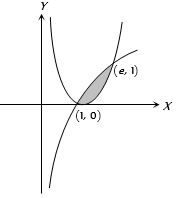
Generate a complete, print-ready paper with questions like this in minutes — across 16+ boards, with answer keys.
$x-2 y=1, x-y+k z=-2, k y+4 z=6, k \in R$
consider the following statements :
$(A)$ The system has unique solution if $k \neq 2$, $k \neq-2$
$(B)$ The system has unique solution if $k =-2$.
$(C)$ The system has unique solution if $k =2$.
$(D)$ The system has no-solution if $k =2$.
$(E)$ The system has infinite number of solutions if $k \neq-2$
Which of the following statements are correct?