MCQ
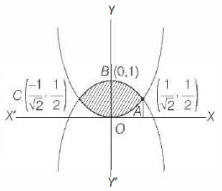
The area bounded by the parabolas $y=x^2$ and $y=1-x^2$ equals
  • A
    $\frac{\sqrt{2}}{3}$
  • $\frac{2 \sqrt{2}}{3}$
  • C
    $\frac{1}{3}$
  • D
    $\frac{2}{3}$

Answer

Correct option: B.
$\frac{2 \sqrt{2}}{3}$
b
(b)

We have, $y=x^2$ and $y=1-x^2$

Intersection point of $y=x^2$ and $y=1-x^2$ is $A\left(\frac{1}{\sqrt{2}}, \frac{1}{2}\right)$ and $C\left(\frac{-1}{\sqrt{2}}, \frac{1}{2}\right)$

Area of shaded region

$=2 \int \limits_0^{1 / \sqrt{2}}\left[\left(1-x^2\right)-\left(x^2\right)\right] d x$

$=2 \int \limits_0^{1 / \sqrt{2}}\left(1-2 x^2\right) d x$

$=2\left[x-\frac{2 x^3}{3}\right]_0^{1 / \sqrt{2}}$

$=2\left[\frac{1}{\sqrt{2}}-\frac{1}{3 \sqrt{2}}\right]$

$=\frac{2}{\sqrt{2}}\left[\frac{3-1}{3}\right]=\frac{2 \sqrt{2}}{3}$ sq units
Need a full question paper?

Generate a complete, print-ready paper with questions like this in minutes — across 16+ boards, with answer keys.

Start Generating Free

Similar questions

If $\hat a,\,\hat b$ and $\hat c$ are unit vectors satisfying $\hat a\, - \,\sqrt 3 \hat b + \hat c\, = \,\vec 0,$ then the angle between the  vectors $\hat a$ and $\hat c$ is 
The value of the integral $\int {\frac{{\sin \,\left( {\ln \,(2 + 2x)} \right)}}{{x + 1}}dx} $ is
If $\text{P(B)}=\frac{3}{5},\text{P}(\text{A}|\text{B})=\frac{1}{2}$ and $\text{P}(\text{A}\cup\text{B})=\frac{4}{5},$ then $\text{P}(\overline{\text{A}\cap\text{B}})+\text{P}(\overline{\text{A}}\cap\text{B})=$
  1. $\frac{1}{5}$
  2. $\frac{4}{5}$
  3. $\frac{1}{2}$
  4. $1$
The possible dimension of a matrix consisting 27 elements is 4.Reason: The number of ways of expressing 27 as a product of two positive integers is 4.
  1. Both Assertion & Reason are individually correct & Reason is correct explanation of Assertion,
  2. Both Assertion & Reason are individually true but Reason is Not the correct explanation of Assertion.
  3. Assertion is correct but Reason is incorrect.
  4. Assertion is incorrect but Reason is correct.
Let $\vec{a}, \vec{b}, \vec{c}$ be unit vectors such that $\vec{a}+\vec{b}+\vec{c}=\overrightarrow{0}$. Which one of the following is correct?
A unit vector in the plane of $i + 2j + k$ and $i + j + 2k$are perpendicular to $2i + j + k$ is
The system of linear equations:
x + y + z = 2
2x + y − z = 3
3x + 2y + kz = 4
has a unique solution if
  1. k ≠ 0
  2. −1 < k < 1
  3. −2 < k < 2
  4. k = 0
If the straight lines $\vec r=$$(1,2,3)+k(\lambda ,2,3),k \in R$  and $\vec r=$$(2,3,1) +k(3,\lambda ,2),k \in R$ intersect at a point , then the interger $\;\lambda $ is equal to . 
Let $f(\theta ) = \sin \theta (\sin \theta + \sin 3\theta )$, then $f(\theta )$
There are $6$ boxes labelled $B_1, B_2, \ldots, B_6$. In each trial, two fair dice $D_1, D_2$ are thrown. If $D_1$ shows $j$ and $D_2$ shows $k$, then $j$ balls are put into the box $B_k$. After $n$ trials, what is the probability that $B_1$ contains at most one ball ?