Question
The area of a square field is $5184cm^2$. A rectangular field, whose length is twice its breadth has its perimeter equal to the perimeter of the square field. Find the area of the rectangular field.

Answer

First, we have to find the perimeter of the square.
The area of the square is $r^2$, where r is the side of the square.
Then, we have the equation as follows,
$r^2= 5184 = (2 \times 2) \times (2 \times 2) \times (2 \times 2) \times (3 \times 3) \times (3 \times 3)$
Taking the square root, we get $r = 2 \times 2 \times 2 \times 3 \times 3 = 72$
Hence the perimeter of the square is $4 \times r = 288m$
Now let L be the length of the rectangular field.
Let W be the width of the rectangular field.
The perimeter is equal to the perimeter of square. Hence, we have,
$2(L + W) = 288$
Moreover, since the length is twice the width,
$L = 2 \times W.$
Substituting this in the previous equation, we get,
$2 \times (2 \times W + W) = 288$
$3 \times W = 144 W$
$= 48$
To find L,
$L = 2 \times W = 2 \times 48 = 96$
Area of the rectangular field $= L \times W = 96 \times 48 = 4608m^2$

Need a full question paper?

Generate a complete, print-ready paper with questions like this in minutes — across 16+ boards, with answer keys.
Start Generating Free

Similar questions

Find the square root of $324$ by the method of repeated subtraction.
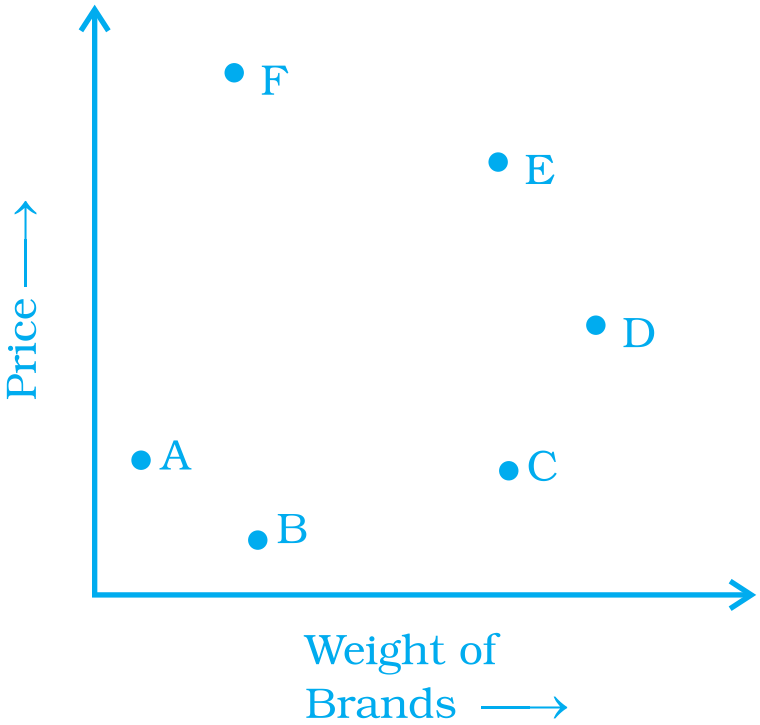
The graph given below compares the price $($ in $Rs.)$ and weight of $6$ bags $($in $kg)$ of sugar of different brands $\text{A, B, C, D, E, F}$.
$a.$ Which brand$(s)$ costs/cost more than Brand $D$?
$b.$ Bag of which brand of sugar is the heaviest?
$c.$ Which brands weigh the same?
$d.$ Which brands are heavier than brand $B$?
$e.$ Which bag is the lightest?
$f.$ Which bags are of the same price?
A dealer bought two tables for $Rs. 3120$. He sold one of them at a loss of $15\%$ and other at a gain of $36\%$. Then he found that each tables was sold for the same price, find the cost price of each table.
Find the following product and verify the result for $x = -1, y = -2:$
$\big(\frac{1}{3}\text{x}−\frac{\text{y}^2}{5}\big)\big(\frac{1}{3}\text{x}+\frac{\text{y}^2}{5}\big)$
Write the following squares of binomials as trinomials: $\big(\frac{\text{x}}{\text{y}}−\frac{\text{y}}{\text{x}})^2$
The following table gives the distances travelled by a car at various time$-$intervals. Study the table and draw a linear graph for the same.
Time
$6 a.m.$
$7 a.m.$
$8 a.m.$
$9 a.m.$
Distance $($ in $km)$
$40$
$80$
$120$
$160$
From your graph, answer the questions given below:
$i.$ How much distance did the car cover during the period from $7:30\ a.m.$ to $8\ a.m.$
$ii.$ What was the time when the car had covered a distance of $100\ km$, since its start?
$iii.$ How much distance had the car covered by $8:30\ a.m.?$
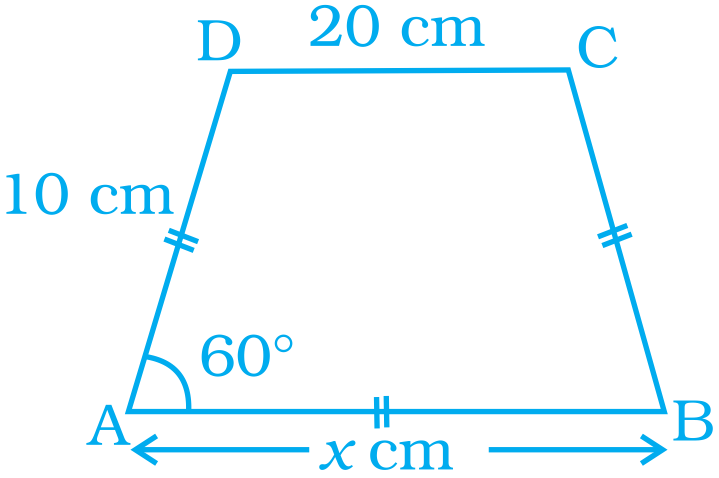
In the following figure, $AB\ ||\ DC$ and $AD = BC$. Find the value of $X$.
Express product as a monomials and verify the result for $x=1, y=2:\left(-x y^3\right) \times\left(y x^3\right) \times(x y)$
With the decrease in prices of tea by $15%$ Tonu, the chaiwallah, was able to buy $2\ kg$ more of tea with the same $Rs. 45$ that he spent each month on buying tea leaves for his chai shop. What was the reduced price of tea? What was the original price of tea?Assessment Report for $2009-2010$
Class: 9B Name: Vidit Atrey Date: $31$ March $2010$
Subject Internal assessment Examination Total Final%
English Literature $\frac{20}{25}$ $\frac{82}{100}$ $\frac{102}{125}$  
English Language $\frac{22}{25}$ $\frac{91}{100}$ $\frac{113}{125}$  
Hindi Literature $\frac{18}{25}$ $\frac{67}{75}$ $\frac{85}{100}$  
Hindi Language $\frac{16}{25}$ $\frac{68}{75}$ $\frac{84}{100}$  
Mathematics $\frac{42}{50}$ $\frac{88}{100}$ $\frac{130}{150}$  
Sanskrit $\frac{14}{20}$ $\frac{75}{100}$ $\frac{99}{120}$  
Physics $\frac{45}{50}$ $\frac{90}{100}$ $\frac{135}{150}$  
Chemistry $\frac{41}{50}$ $\frac{82}{100}$ $\frac{123}{150}$  
Biology $\frac{43}{50}$ $\frac{87}{100}$ $\frac{130}{150}$  
History and Civics $\frac{19}{25}$ $\frac{68}{75}$ $\frac{87}{100}$  
Geography $\frac{17}{20}$ $\frac{71.5}{80}$ $\frac{88.5}{100}$  
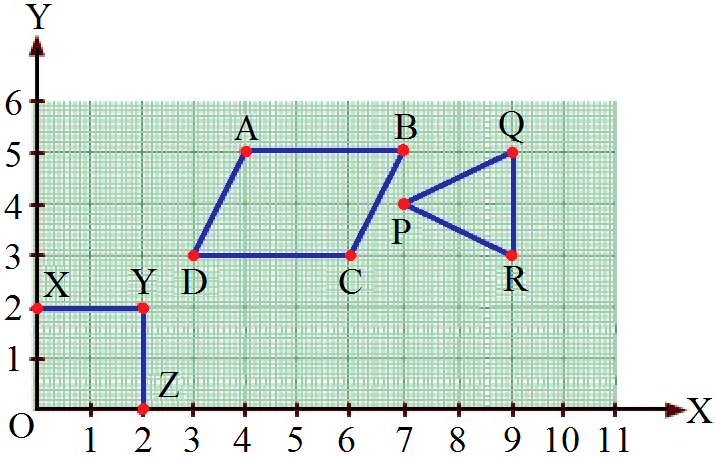
Write the coordinates of each of the vertices of each polygon in Figure.