Question
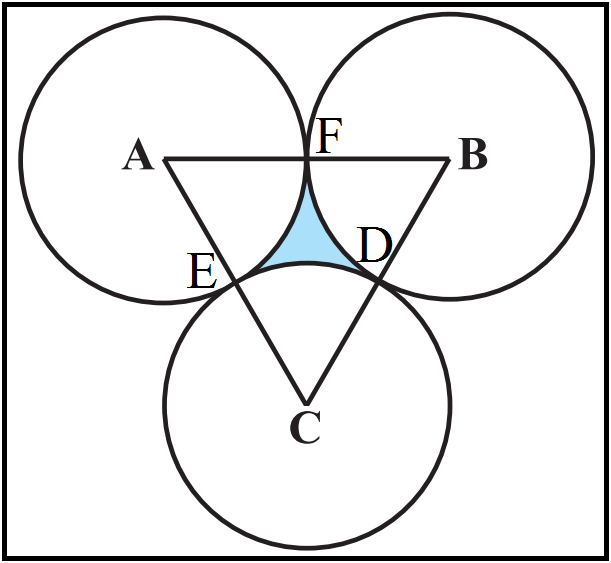
The area of an equilateral triangle is $49\sqrt{3}\text{cm}^2.$ taking each angular point as centre, circles are drawn with radius equal to half the length of the side of the triangle. Find the area of the triangle not included in the circles. $\big[\text{Take }\sqrt{3}=1.73\big]$
Answer

Area of equilateral triangle $\text{ABC}=49\sqrt{3}\text{cm}^2$

Let a be its side
$\therefore\frac{\sqrt{3}}{4}\text{a}^2=49\sqrt{3}$
Or $\text{a}^2=49\times4$
$\therefore\text{a}=7\times2$
$\Rightarrow\text{a}=14\text{cm}$
Area of sector $\text{BDF}=\pi\text{r}^2\times\frac{\theta}{360^\circ}$
$=\frac{22}{7}\times7\times7\times\frac{60}{360}\text{cm}$
$=\frac{11\times7}{3}\text{cm}^2=\frac{77}{3}\text{cm}^2$
Area pf sector $BDF =$ Area of sector $CDE =$ Area of sector $AEF$
Sum of area of all the sectors
$=\frac{77}{3}\times3\text{cm}^2=77\text{cm}^2$
$\therefore$ Shaded area = Area of $\triangle\text{ABC}$ - Sum of area of all sectors
$=49\sqrt{3}-77\text{cm}^2=(84.77-77.00)\text{cm}^2$
$=7.77\text{cm}^2$

Need a full question paper?

Generate a complete, print-ready paper with questions like this in minutes — across 16+ boards, with answer keys.

Start Generating Free

Similar questions

A man standing on the deck of a ship, which is $8 \ m$ above water level. He observes the angle of elevation of the top of a hill as $60^{\circ}$ and the angle of depression of the base of the hill as $30^{\circ}$. Calculate the distance of the hill from the ship and the height of the hill.
A wooden toy rocket is in the shape of a cone mounted on a cylinder as shown in given below figure. The height of the entire rocket is $26 \ cm,$ while the height of the conical part is $6 \ cm.$ The base of the conical portion has a diameter of $5 \ cm,$ while the base diameter of the cylindrical portion is $3 \ cm.$ If the conical portion is to be painted orange and the cylindrical portion yellow, find the area of the rocket painted with each of these colours. $($Take $\pi =3.14)$​​​​​​​
Solve for $x$ and $y$
$7(y + 3) - 2(x + 2) = 14,$
$4(y - 2) + 3(x - 3) = 2$
If $\tan\theta=\frac{1}{\sqrt{7}},$ show that $\frac{\big(\text{coses}^2\theta-\sec^2\theta\big)}{\big(\text{cosec}^2\theta+\sec^2\theta\big)}=\frac34.$
Solve for $x$ and $y$
$\frac{1}{(3\text{x}+\text{y)}}+\frac{1}{(3\text{x}-\text{y)}}=\frac{3}{4},$
$\frac{1}{2(3\text{x}+\text{y)}}-\frac{1}{2(3\text{x}-\text{y)}}=\frac{-1}{8}$
Find the roots of the following equation, if they exist, by applying the quadratic formula:
$x^2-4 a x-b^2+4 a^2=0$
Solve the following system of equations by the method of cross-multiplication:
$\frac{5}{\text{x}+\text{y}}-\frac{2}{\text{x}-\text{y}}=-1,$
$\frac{15}{\text{x}+\text{y}}+\frac{7}{\text{x}-\text{y}}=-10,$ where $\text{x}\neq0$ and $\text{y}\neq0.$
It is given that $-1$ is one of the zeros of the polynomial $x^3 + 2x^2 - 11x - 12$. Find all the given zeros of the given polynomial.
Draw the graphs of the lines $x = -2$, and $y = 3$. Write the vertices of the figure formed by these lines, the x-axis and the y-axis. Also, find the area of the figure.
In the following, determine the set of values of k for which the given quadratic equation has real root:
$2 x^2-5 x-k=0$