Question
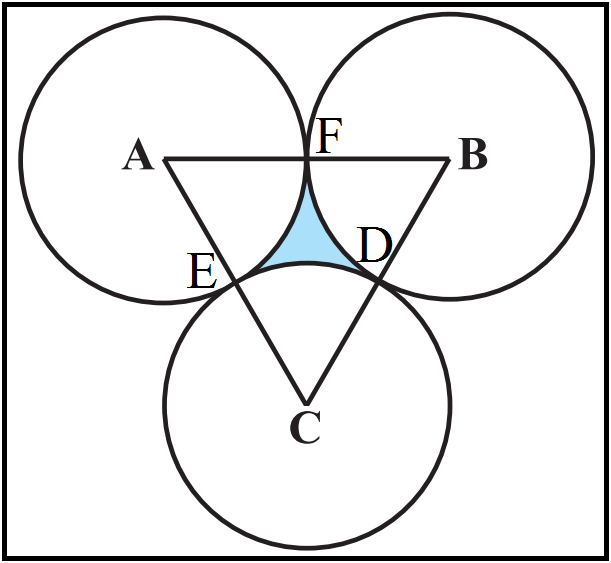
The area of an equilateral triangle is $49\sqrt{3}\text{cm}^2.$ taking each angular point as centre, circles are drawn with radius equal to half the length of the side of the triangle. Find the area of the triangle not included in the circles. $\big[\text{Take }\sqrt{3}=1.73\big]$
Answer

Area of equilateral triangle $\text{ABC}=49\sqrt{3}\text{cm}^2$
Let a be its side $\therefore\frac{\sqrt{3}}{4}\text{a}^2=49\sqrt{3}$ Or $\text{a}^2=49\times4$ $\therefore\text{a}=7\times2$ $\Rightarrow\text{a}=14\text{cm}$ Area of sector $\text{BDF}=\pi\text{r}^2\times\frac{\theta}{360^\circ}$ $=\frac{22}{7}\times7\times7\times\frac{60}{360}\text{cm}$ $=\frac{11\times7}{3}\text{cm}^2=\frac{77}{3}\text{cm}^2$ Area pf sector BDF = Area of sector CDE = Area of sector AEF Sum of area of all the sectors $=\frac{77}{3}\times3\text{cm}^2=77\text{cm}^2$ $\therefore$ Shaded area = Area of $\triangle\text{ABC}$ - Sum of area of all sectors $=49\sqrt{3}-77\text{cm}^2=(84.77-77.00)\text{cm}^2$ $=7.77\text{cm}^2$

Need a full question paper?

Generate a complete, print-ready paper with questions like this in minutes — across 16+ boards, with answer keys.

Start Generating Free

Similar questions

The houses in a row are numbered consecutively from 1 to 49. Show that there exists a value of X such that sum of houses preceding the house numbered X is equal to sum of the numbers of houses following X.
The area of a rhombus is $480cm^2$​​​​​​​, and one of its diagonals measures 48cm.
Find:
  1. The length of the other diagonal.
  2. The length of each of its sides.
  3. Its perimeter.
Find the zeros of the following quadratic polynomial and verify the relationship between the zeros and the coefficients:
$4x^2 - 4x + 1$
From the top of a $7 m$ high building, the angle of elevation of the top of a cable tower is $60^{\circ}$ and the angle of depression of its foot is $45^{\circ}$. Determine the height of the tower.
Obtain all other zeros of $(x^4 + 4x^3 - 2x^2 - 20x - 15)$ if two of its zeros are $\sqrt5$ and $-\sqrt5.$
Write the denominator of the rational number $\frac{257}{5000}$ in the form $2^m \times 5^n$​​​​​​​, where m, n are non-negative integers. Hence, write the decimal expansion, without actual division.
Two circles with centres O and O' of radii 3cm and 4cm, respectively intersect at two points P and Q such that OP and O'P are tangents to the two circles. Find the length of the common chord PQ.
If the sum of first n term is $(3n^2 + 5n)$, find its common difference.
The perimeter of a right triangle is 40cm and its hypotenuse measures 17cm. Find the area of the triangle.
Solve the following systems of equations:
21x + 47y = 110,
47x + 21y = 162.