The area of cross section of the rope used to lift a load by a crane is $2.5 \times 10^{-4} m ^{2}$. The maximum lifting capacity of the crane is $10$ metric tons. To increase the lifting capacity of the crane to $25$ metric tons, the required area of cross section of the rope should be.$.........\times 10^{-4} \,m ^{2}$ (take $g =10\, ms ^{-2}$ )
JEE MAIN 2022, Medium
Download our app for free and get started
Since breaking stress (Maximum lifting capacity) is the property of material so it will remain same. breaking stress $=\frac{\text { Maximum lifting capacity }}{\text { Area of cross section of rope }}$ $\frac{10}{2.5 \times 10^{-4}}=\frac{25}{ A }$
$A =625 \times 10^{-6}$
$=6.25 \times 10^{-4} m ^{2}$

Download our appand get started for free
Experience the future of education. Simply download our apps or reach out to us for more information. Let's shape the future of learning together!No signup needed.*
Similar Questions
- 1Two wires of equal lengths are made of the same material. Wire $A$ has a diameter that is twice as that of wire $B$. If identical weights are suspended from the ends of these wires, the increase in length isView Solution
- 2For a constant hydraulic stress on an object, the fractional change in the object's volume $\left( {\frac{{\Delta V}}{V}} \right)$ and its bulk modulus $(B)$ are related asView Solution
- 3View SolutionAssume that a block of very low shear modulus is fixed on an inclined plane as shown. Due to elastic forces it will deform. What will be the shape of the block ?
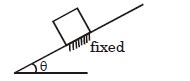
- 4View SolutionIf the temperature increases, the modulus of elasticity
- 5Two wires of same length and radius are joined end to end and loaded. The Young's modulii of the materials of the two wires are $Y_{1}$ and $Y_{2}$. The combination behaves as a single wire then its Young's modulus is:View Solution
- 6View SolutionThe ratio of the adiabatic to isothermal elasticities of a triatomic gas is
- 7A uniform rod of mass $m$, length $L$, area of cross-section $A$ and Young's modulus $Y$ hangs from the ceiling. Its elongation under its own weight will beView Solution
- 8A rod of length $l$ and area of cross-section $A$ is heated from $0°C$ to $100°C$. The rod is so placed that it is not allowed to increase in length, then the force developed is proportional toView Solution
- 9A wire elongates by $l$ $mm$ when a load $W$ is hanged from it. If the wire goes over a pulley and two weights $W$ each are hung at the two ends, the elongation of the wire will be (in $mm$)View Solution
- 10View SolutionThe shear strain is possible in .............