The atmospheric pressure at a place is $10^5 \,Pa$. If tribromomethane (specific gravity $=2.9$ ) be employed as the barometric liquid, the barometric height is .......... $m$
Easy
Download our app for free and get started
(a)
$1 \,atm \simeq 10^5 \,Pa =76 \,cm$ of $Hg$
Density of $Hg =13.6$
$\rho_{H g} \times g \times h_{H g}=\rho_{T B M} \times g \times h_{T B M}$ $\left\{\begin{aligned} \rho_{H g}= \text { density of } Hg \\ h_{H g}= \text { height of } Hg \\ \rho_{T B M}= \text { density of } \\ \text { tribromomethane } \\ h_{T B M}= \text { height of tribromomethane } \end{aligned}\right.$
Substituting values
$13.6 \times 76=2.9 \times h$
$3.52 \,m=h$

Download our appand get started for free
Experience the future of education. Simply download our apps or reach out to us for more information. Let's shape the future of learning together!No signup needed.*
Similar Questions
- 1The density of the atmosphere at sea level is $1.29 \;kg / m ^{3} .$ Assume that it does not change with altitude. Then how high (in $km$) would the atmosphere extend?View Solution
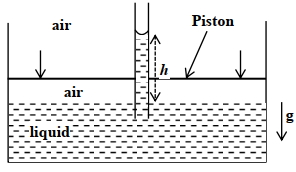
- 2An incompressible liquid is kept in a container having a weightless piston with a hole. A capillary tube of inner radius $0.1 \mathrm{~mm}$ is dipped vertically into the liquid through the airtight piston hole, as shown in the figure. The air in the container is isothermally compressed from its original volume $V_0$ to $\frac{100}{101} V_0$ with the movable piston. Considering air as an ideal gas, the height $(h)$ of the liquid column in the capillary above the liquid level in $\mathrm{cm}$ is. . . . . . .View Solution
[Given: Surface tension of the liquid is $0.075 \mathrm{Nm}^{-1}$, atmospheric pressure is $10^5 \mathrm{~N} \mathrm{~m}^{-2}$, acceleration due to gravity $(g)$ is $10 \mathrm{~m} \mathrm{~s}^{-2}$, density of the liquid is $10^3 \mathrm{~kg} \mathrm{~m}^{-3}$ and contact angle of capillary surface with the liquid is zero]
- 3View SolutionA solid cube and a solid sphere both made of same material are completely submerged in water but to different depths. The sphere and the cube have same surface area. The buoyant force is
- 4A air bubble of radius $1\,cm$ in water has an upward acceleration $9.8\, cm\, s ^{-2}$. The density of water is $1\, gm\, cm ^{-3}$ and water offers negligible drag force on the bubble. The mass of the bubble is$.......gm$View Solution
$\left( g =980 \,cm / s ^{2}\right)$
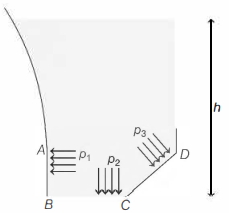
- 5A tall tank filled with water has an irregular shape as shown. The wall $C D$ makes an angle of $45^{\circ}$ with the horizontal, the wall $A B$ is normal to the base $B C$. The lengths $A B$ and $C D$ are much smaller than the height $h$ of water (figure not to scale). Let $p_1, p_2$ and $p_3$ be the pressures exerted by the water on the wall $A B$, base $B C$ and the wall $C D$ respectively. Density of water is $\rho$ and $g$ is acceleration due to gravity. Then, approximatelyView Solution
- 6Three liquids of equal masses are taken in three identical cubical vessels $A, B$ and $C .$ Their densities are $\rho_{A}, \rho_{B}$ and $\rho_{C} \cdot$ The force exerted by the liquid on the base of the cubical vessel isView Solution
- 7Under a constant pressure head, the rate of flow of liquid through a capillary tube is $V$. If the length of the capillary is doubled and the diameter of the bore is halved, the rate of flow would becomeView Solution
- 8A Spherical ball of radius $1 mm$ and density $10.5 g / cc$ is dropped in glycerine of coefficient of viscosity $9.8$ poise and density $1.5 g / cc$. Viscous force on the ball when it attains constant velocity is $3696 \times 10^{-x} N$. The value of $x$ is $\text { (Given, } g =9.8 m / s ^2 \text { and } \pi=\frac{22}{7} \text { ) }$View Solution
- 9Two bodies are in equilibrium when suspended in water from the arms of a balance. The mass of one body is $36 g $ and its density is $9 g / cm^3$. If the mass of the other is $48 g$, its density in $g / cm^3$ isView Solution
- 10Air of density $1.2\,kg\,m^{-3}$ is blowing across the horizontal Wings of an aeroplane in such a way that its speeds above and below the wings are $150\,ms^{-1}$ and $100\,ms^{-1}$, respectively. The pressure difference between the upper and lower sides of the Wings, is ........ $Nm^{-2}$View Solution