Question
The atom of an element X has 7 electrons in its M shell:
  1. Write the electronic configuration of element X.
  2. What is the atomic number of element X?
  3. Is it a metal or a non-metal?
  4. What type of ion will be formed by an atom of element X? Write the symbol of the ion formed.
  5. What could element X be?

Answer

  1. Electronic configuration of the element X is,

Element X: $\text{K}\ \ \ \ \ \ \text{L}\ \ \ \ \ \ \text{M}\\2\ \ \ \ \ \ \ 8\ \ \ \ \ \ \ 7$

  1. Atomic number of the element X will be 17
  2. Element X is a non-metal because there are 7 electrons in its outermost orbit. In order to complete its octet (to get 8 electrons), it will gain one electron. An element which gains electrons in order to complete its octet is a non-metal.
  3. The element will form an anion by gaining an extra electron in order to complete its octet. Symbol of an ion of X will be X-
  4. X is Chlorine.

Need a full question paper?

Generate a complete, print-ready paper with questions like this in minutes — across 16+ boards, with answer keys.

Start Generating Free

Similar questions

Describe the composition and functions of blood

Name major phyla of Animal kingdom. Write down one character and one example of each of them.

Explain with examples

  1. Atomic number,
  2. Mass number,
  3. Isotopes,
  4. Isobars.

Give any two uses of isotopes.

On the basis of shape and functions of cells how epithelial tissues are classified? Explain with diagram the various types of epithelial tissues.
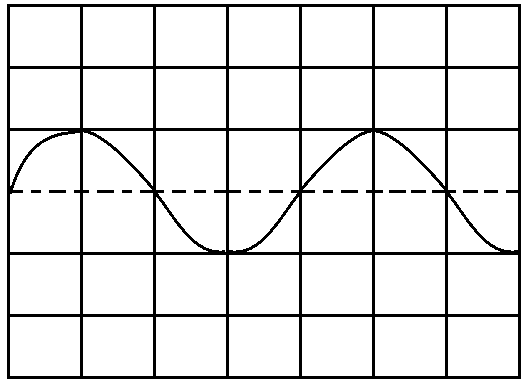
Figure X showa a trace of a sound wave produced by a particular tuning fork:


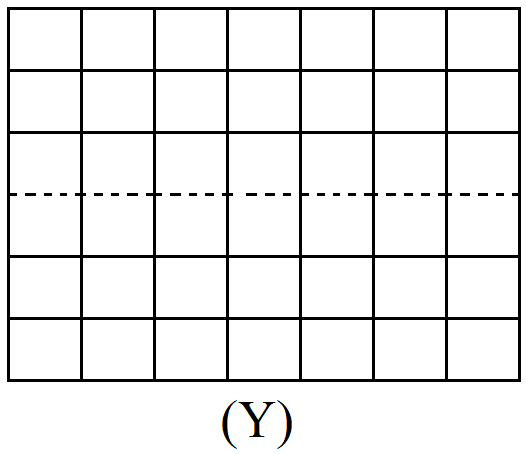
  1. On the graph paper given in Figure Y, draw a trace of the sound wave which has higher frequency than that shown in Figure X.
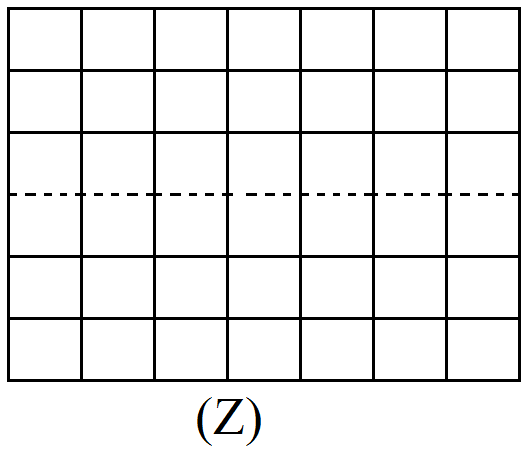
  2. On the graph paper shoen in Figure Z, draw a trace of the sound wave which has a larger amplitude than that shown in Figure X.
Mention differences between light microscope and electron microscope.
Describe the various steps involved in the separation of iodine, iron filings and salt from a mixture.
Double Matching:

Match the columns I, II and III.

 
Column I
 
Column II
 
Column III
1.
Oil seeds
a.
Red Sindhi
i.
Sahiwal
2.
Intercropping
b.
Mustard
ii.
Sunflower
3.
Local breeds
c.
Vitamin A
iii.
Maize
4.
Poultry feed
d.
Soybean
iv.
Vitamin K

Describe general characteristics of phylum Annelida. Give one example each class of Annelida.

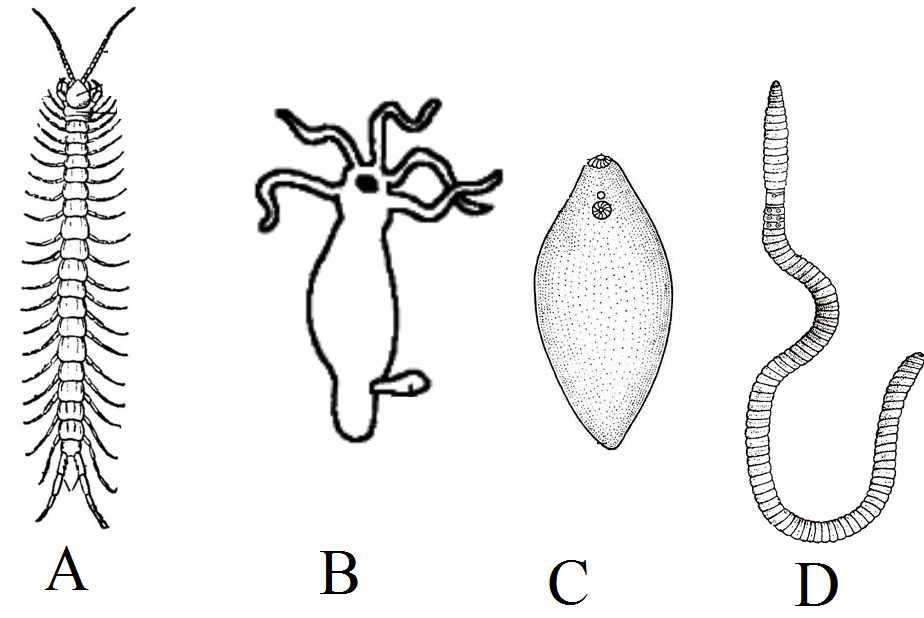
  1. Identify figure A to D.
  2. Which one of them is (i) diplobalstic; (ii) Coelomate?
  3. Which triplobalstic animal is (i) Acoelomate; (ii) Coelomate?
  4. Which one belong to phylum (i) Cnidaria; (ii) Platyhelminthes; (iii) Annelids; (iv) Arthropoda?
  5. Which one of them has (i) Organ level organization? (ii) Organ system level organization?
  6. Which one of them has excretory organs in the form of (i) Flame cells; (ii) Nephridia?
  7. Which one of them has trachea as the respiratory organ?