Question
The atom of an element $X$ has $7$ electrons in its $M$ shell:
a. Write the electronic configuration of element X .
b. What is the atomic number of element $X$ ?
c. Is it a metal or a non-metal?
d. What type of ion will be formed by an atom of element $X$ ? Write the symbol of the ion formed.
e. What could element $X$ be?

Answer

  1. Electronic configuration of the element $X$ is,
Element X: $\text{K}\ \ \ \ \ \ \text{L}\ \ \ \ \ \ \text{M}\\2\ \ \ \ \ \ \ 8\ \ \ \ \ \ \ 7$
  1. Atomic number of the element $X$ will be $17$
  2. Element $X$ is a non-metal because there are $7$ electrons in its outermost orbit. In order to complete its octet (to get $8$ electrons), it will gain one electron. An element which gains electrons in order to complete its octet is a non-metal.
  3. The element will form an anion by gaining an extra electron in order to complete its octet. Symbol of an ion of $X$ will be $X^-$
  4. $X$ is Chlorine.

Need a full question paper?

Generate a complete, print-ready paper with questions like this in minutes — across 16+ boards, with answer keys.

Start Generating Free

Similar questions

When a beam of sunlight enters a room through a window, we can see tiny particles X suspended in a gas (or rather a mixture of gases) Y which are moving rapidly in a very haphazard manner.
  1. What could particles X be?
  2. Name the gas (or mixture of gases) Y.
  3. What is the phenomenon exhibited by particles X known as?
  4. What is causing the movement of particles X?
  5. What conclusion does the existence of this phenomenon give us about the nature of matter?
When extremely small particles X derived from the another of a flower were suspended in a liquid Y and observed through a microscope, it was found that the particles X were moving throughout the liquid Y in a very zig zag way. It was also observed that warmer the liquid Y, faster the particles X moved in its surface.
  1. What could particles X be?
  2. What do you think liquid Y is?
  3. What is the zig-zag movement of particles X?
  4. What is causing the zig-zag movement of particles X?
  5. Name the scientist who discovered this phenomenon.
  6. What does this experiment tell us about the nature of liquid Y?
A truck of mass $500\ kg$ moving at 4m/s collides with another truck of mass $1500\ kg$ moving in the same direction at 2m/s. What is their common velocity just after the collision if they move off together?
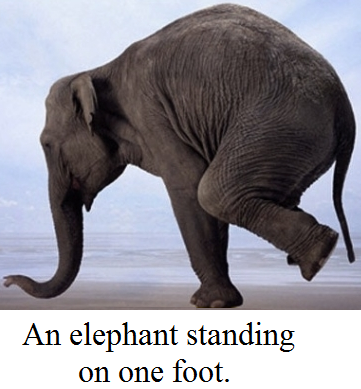
An elephant weighing $40,000\ N$ stands on one foot of area $1000\ cm^2$ whereas a girl weighing $400\ N$ is standing on one ‘stiletto’ heel of area $1cm^2.$​​​​​​​

  1. Which of the two, elephant or girl, exerts a larger force on the ground and by how much?
  2. What pressure is exerted on the ground by the elephant standing on one foot?
  3. What pressure is exerted on the ground by the girl standing on one heel?
  4. Which of the two exerts larger pressure on the ground: elephant or girl?
  5. What is the ratio of pressure exerted by the girl to the pressure exerted by the elephant?
A gun of mass $3\ kg$ fires a bullet of mass $30\ g$. The bullet takes $0.003\ s$ to move through the barrel of the gun and acquires a velocity of $100\ m/s$. Calculate:
  1. The velocity with which the gun recoils.
  2. The force exerted on gunman due to recoil of the gun.
A stone is dropped from a height of $20\ m.$
How long will it take to reach the ground?
How many grams of magnesium will have the same number of atoms as $6$ grams of carbon?
$(Mg = 24\ u; C = 12\ u)$
If $1$ gram of sulphur dioxide contains $x$ molecules, how many molecules will be present in $1$ gram of oxygen?
$(S = 32\ u; O = 16\ u)$
How will you separate a mixture of kerosene oil and water? Explain with the help of a labeled diagram
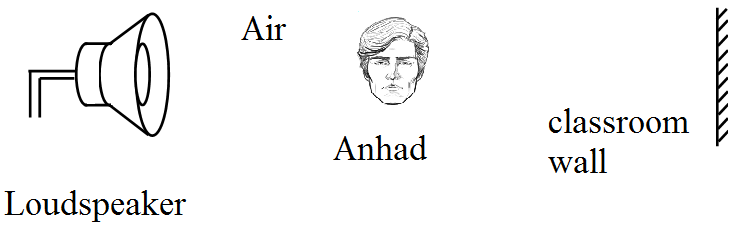
In an experiment, Anhad studies sound waves. He sets up a loudspeaker to produce sound as shown below:
Anhad adjusts the signal to the loudspeaker to give a sound of frequency 200Hz.
  1. What happens to the air in-between Anhas and the loudspeaker?
  2. Explain how Anhad receives sound in both ears.