MCQ
The atomic number of an element represents
  • A
    Number of neutrons in the nucleus
  • Number of protons in the nucleus
  • C
    Atomic weight of element
  • D
    Valency of element

Answer

Correct option: B.
Number of protons in the nucleus
b
(b) Atomic number is defined as the number of protons in the nucleus.

Need a full question paper?

Generate a complete, print-ready paper with questions like this in minutes — across 16+ boards, with answer keys.
Start Generating Free

Similar questions

When $22.4$ litres of $H_{2(g)}$ is mixed with $11.2$ litres of $Cl_{2(g)}$, each at $S.T.P,$ the moles of $HCl_{(g)} $ formed is equal to
The correct shape and $I-I-I$ bond angles respectively in $I _{3}^{-}$ ion are :-
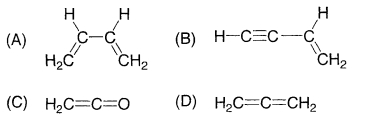
Amongst the given options, the compound$(s)$ in which all the atoms are in one plane in all the possible conformations (if any), is (are) $Image$
Following solutions were prepared by mixing different volumes of $NaOH$ and $HCl$ of different concentrations

$(a)\;\;60\; \mathrm{mL} \frac{\mathrm{M}}{10}\; \mathrm{HCl}+40 \;\mathrm{mL} \frac{\mathrm{M}}{10} \;\mathrm{NaOH}$

$(b)\;\;55\; \mathrm{mL} \frac{\mathrm{M}}{10}\; \mathrm{HCl}+45 \;\mathrm{mL} \frac{\mathrm{M}}{10} \;\mathrm{NaOH}$

$(c)\;\;75\; \mathrm{mL} \frac{\mathrm{M}}{5}\; \mathrm{HCl}+25 \;\mathrm{mL} \frac{\mathrm{M}}{5} \;\mathrm{NaOH}$

$(d)\;\;100\; \mathrm{mL} \frac{\mathrm{M}}{10}\; \mathrm{HCl}+100 \;\mathrm{mL} \frac{\mathrm{M}}{10} \;\mathrm{NaOH}$

$pH$ of which one of them will be equal to $1$ ?
The equivalent weight of $H_3PO_4$  in following reaction is 
$H_3PO_4 + Ca(OH)_2 \to  CaHPO_4 + 2H_2O$
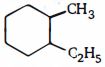
How many geometrical isomers are possible for the above compound ?
A hydrocarbon containing $2$ carbon atoms gives Sabatier and Senderen's reaction but does not give precipitate with ammoniacal silver nitrate solution. The hydrocarbon in the question is
Which one of the following statements is incorrect in relation to ionization enthalpy?
Consider the following changes

$M(s) \to M(g)\,\,\,\,\,\,\,\,\,\,\,\,\,\, ........(1)$

$M(s) \to M^{2+} (g) + 2e^-\,\,\,\,\,\,\,\,.......(2)$

$M(g) \to M^+(g) + e^-\,\,\,\,\,\,\,\,\,\,\,.........(3)$

$M^+ (g) \to M^{2+} (g) + e^-\,\,\,\,\,\,\,\,\,.........(4)$

$M(g) \to M^{2+} (g) +2e^-\,\,\,\,\,\,\,\,\,\,\,..........(5)$

The second ionization energy of $M$ could be calculated from the energy  values assoclated with

Chemical equation is balanced according to the law of