MCQ
The audio signal:
  • A
    Can be sent directly over the air for large distance
  • Cannot be sent directly over the air for large distance
  • C
    Posses very high frequency
  • D
    None of above

Answer

Correct option: B.
Cannot be sent directly over the air for large distance

An Audio signal may vary from $20\ Hz$ to $20\ KHz$, But in general, it is around $200\ Hz$ only,.
This Frequency when transmitted directly to air for long$-$distance is attenuated and a signal is lost in the air, That's why such frequency is first modulated to higher frequencies of order $(MHz)$ and then transmitted to air.
Hence audio signals can't be transmitted directly to air for long distances.

Need a full question paper?

Generate a complete, print-ready paper with questions like this in minutes — across 16+ boards, with answer keys.
Start Generating Free

Similar questions

In a hydrogen discharge tube it is observed that through a given cross-section $3.13\times 10^{15}$ electrons are moving from right to left and $3.12\times 10^{15}$ protons are moving from left to right. What is the electric current in the discharge tube and what is its direction
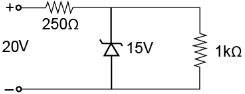
A Zener diode, having breakdown voltage equal to $15\,\,V,$ is used in a voltage regulator circuit shown in figure. The current through the diode is......$mA$
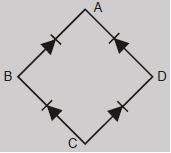
For the given circuit shown in fig, to act as full wave rectifier :-  $a.c.$ input should be  connected across .............. and ................. the $d.c.$ output would appear across  ............. and ..................
A point object is placed at a distance of 10 cm and its real image is formed at a distance of 20 cm from a concave mirror. If the object is moved by 0.1 cm towards the mirror, the image will shift by about
If $E$ and $B$ represent electric and magnetic field vectors of the electromagnetic wave, the direction of propagation of electromagnetic wave is along,
A charged $30\,\mu F$ capacitor is connected to a $27\,mH$ inductor. The angular frequency of free oscillations of the circuit is
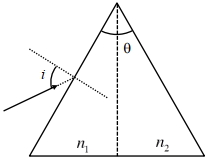
For a prism of prism angle $\theta=60^{\circ}$, the refractive indices of the left half and the right half are, respectively, $n_1$ and $n_2\left(n_2 \geq n_1\right)$ as shown in the figure. The angle of incidence $i$ is chosen such that the incident light rays will have minimum deviation if $n_1=n_2=n=1.5$. For the case of unequal refractive indices, $n_1=n$ and $n_2=n+\Delta n$ (where $\Delta n \ll n$ ), the angle of emergence $e=i+\Delta e$.

Which of the following statement($s$) is (are) correct?

$(A)$ The value of $\Delta e$ (in radians) is greater than that of $\Delta n$

$(B)$ $\Delta e$ is proportional to $\Delta n$

$(C)$ $\Delta e$ lies between 2.0 and 3.0 milliradians, if $\Delta n=2.8 \times 10^{-3}$

$(D)$ $\Delta e$ lies between 1.0 and 1.6 milliradians, if $\Delta n=2.8 \times 10^{-3}$
In an electromagnetic wave.
By placing the prism in minimum deviation position, images of the spectrum
A charged particle is moving in a circular orbit of radius $6\, cm$ with a uniform speed of $3 \times 10^6\, m/s$ under the action of a uniform magnetic field $2 \times 10^{-4}\, Wb/m^2$ which is at right angles to the plane of the orbit. The charge to mass ratio of the particle is