-
$\text{A}\omega^2$
-
$\frac{\text{A}\omega^2}{2}$
-
$\frac{\text{A}\omega^2}{\sqrt{2}}$
-
$\text{Zero}.$
$\text{A}\omega^2$
$\frac{\text{A}\omega^2}{2}$
$\frac{\text{A}\omega^2}{\sqrt{2}}$
$\text{Zero}.$
Explanation:
The acceleration changes its direction (to opposite direction) after every half oscillation. Thus, net acceleration is given as,
$\text{A}\omega^2+(-\text{A}\omega^2)=0$
Generate a complete, print-ready paper with questions like this in minutes — across 16+ boards, with answer keys.
The ratio of areas within the electron orbits for the first excited state to the ground state for hydrogen atom is
| (a) 16 : 1 | (b) 18 : 1 | (c) 4 : 1 | (d) 2 : 1 |
A bar magnet is oscillating in the Earth’s magnetic field with a period T. What happens to its period and motion if its mass is quadrupled
|
(a) Motion remains S.H.M. with time period = 2T |
|
(b) Motion remains S.H.M. with time period = 4T |
|
(c) Motion remains S.H.M. and period remains nearly constant |
|
(d) Motion remains S.H.M. with time period = |
A charge produces an electric field of 1 N/C at a point distant 0.1 m from it. The magnitude of charge is
|
(a) 1.11 |
(b) 9.11 |
(c) 7.11 |
(d) None of these |
The path executed by a charged particle whose motion is perpendicular to magnetic field i
|
(a) A straight line |
(b) An ellipse |
(c) A circle |
(d) A helix |
Ionization energy of hydrogen is 13.6 eV. If h = 6.6
, the value of R will be of the order of
|
(a) |
(b) |
(c) |
(d) |
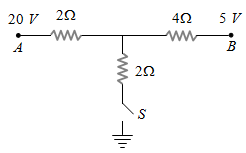
As the switch S is closed in the circuit shown in figure, current passed through it is

|
(a) 4.5 A |
(b) 6.0 A |
(c) 3.0 A |
(d) Zero |
Two electric bulbs whose resistances are in the ratio of 1 : 2 are connected in parallel to a constant voltage source. The powers dissipated in them have the ratio
|
(a) 1 : 2 |
(b) 1 : 1 |
(c) 2 : 1 |
(d) 1 : 4 |