MCQ
The average acceleration vector for a particle having a uniform circular motion is
  • A
    A constant vector of magnitude $\frac{{{v^2}}}{r}$
  • B
    A vector of magnitude $\frac{{{v^2}}}{r}$ directed normal to the plane of the given uniform circular motion
  • C
    Equal to the instantaneous acceleration vector at the start of the motion
  • A null vector

Answer

Correct option: D.
A null vector
d
(d)In complete revolution change in velocity becomes zero so average acceleration will be zero.

Need a full question paper?

Generate a complete, print-ready paper with questions like this in minutes — across 16+ boards, with answer keys.

Start Generating Free

Similar questions

One mole of an ideal gas requires $207J$ heat to raise the temperature by $10K,$ when heated at constant pressure. If the same gas is heated at constant volume to raise the temperature by $10K,$ then heat required is:
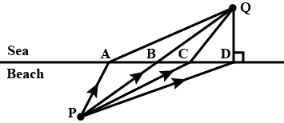
A girl standing at point $P$ on a beach wishes to reach a point $Q$ in the sea as quickly as possible. She can run at $6 \,kmh ^{-1}$ on the beach and swim at $4 \,kmh ^{-1}$ in the sea. She should take the path
The two vectors have magnitudes $3$ and $5$. If angle between them is $60^o$, then the dot product of two vectors will be
Given below are two statements. One is labelled as Assertion $A$ and the other is labelled as Reason $R$.

Assertion A :Two identical balls $A$ and $B$ thrown with same velocity '$u$ ' at two different angles with horizontal attained the same range $R$. If $A$ and $B$ reached the maximum height $h_{1}$ and $h_{2}$ respectively, then $R =4 \sqrt{ h _{1} h _{2}}$

Reason R: Product of said heights.

$h _{1} h _{2}=\left(\frac{u^{2} \sin ^{2} \theta}{2 g }\right) \cdot\left(\frac{u^{2} \cos ^{2} \theta}{2 g }\right)$

Choose the $CORRECT$ answer 

If $97.52$ is divided by $2.54$, the correct result in terms of significant figures is
A particle of mass $m$ is under the influence of the gravitational field of a body of mass $M(\gg m)$. The particle is moving in a circular orbit of radius $r_0$ with time period $T_0$ around the mass $M$. Then, the particle is subjected to an additional central force, corresponding to the potential energy $V_c(r)=m \alpha / r^3$, where $\alpha$ is a positive constant of suitable dimensions and $r$ is the distance from the center of the orbit. If the particle moves in the same circular orbit of radius $r_0$ in the combined gravitational potential due to $M$ and $V_c(r)$, but with a new time period $T_1$, then $\left(T_1^2-T_0^2\right) / T_1^2$ is given by [ $G$ is the gravitational constant.]
A force of $6.4\, N$ stretches a vertical spring by $0.1 \,m$. The mass that must be suspended from the spring so that it oscillates with a period of $\left( {\frac{\pi }{4}} \right)sec$. is  ... $kg$
Pressure is a scalar quantity because:
A physical quantity is measured and its value is found to be $nu$ where $n = $ numerical value and $u = $ unit. Then which of the following relations is true
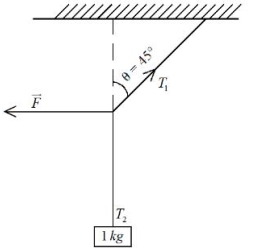
A $1 \mathrm{~kg}$ mass is suspended from the ceiling by a rope of length $4 \mathrm{~m}$. A horizontal force ' $F$ ' is applied at the mid point of the rope so that the rope makes an angle of $45^{\circ}$ with respect to the vertical axis as shown in figure. The magnitude of $F$ is: