MCQ
The average acceleration vector for a particle having a uniform circular motion is
  • A
    A constant vector of magnitude $\frac{{{v^2}}}{r}$
  • B
    A vector of magnitude $\frac{{{v^2}}}{r}$ directed normal to the plane of the given uniform circular motion
  • C
    Equal to the instantaneous acceleration vector at the start of the motion
  • A null vector

Answer

Correct option: D.
A null vector
d
(d)In complete revolution change in velocity becomes zero so average acceleration will be zero.

Need a full question paper?

Generate a complete, print-ready paper with questions like this in minutes — across 16+ boards, with answer keys.

Start Generating Free

Similar questions

A frictionless pulley is attached to one arm of a balance and a string passed around it carries two masses $m_1$ and $m_2$. The pulley is provided with $a$ clamp due to which $m_1$ and $m_2$ do not move $w.r.t.$ each other. On removing the clamp, if the counter mass restores balance, then acceleration of centre of mass of the masses $m_1$ and $m_2$ will have acceleration of magnitude ? 
The position vector of a particle related to time $t$ is given by $\overrightarrow{ r }=\left(10 t \hat{ i }+15 t ^2 \hat{ j }+7 \hat{ k }\right) m$ The direction of net force experienced by the particle is
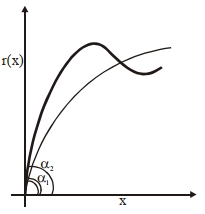
A projectile is launched from the origin in the $xy$ plane ( $x$ is the horizontal and $y$ is the vertically up direction) making an angle $\alpha$ from the $x$-axis. If its distance. $r =\sqrt{ x ^2+ y ^2}$ from the origin is plotted against $x$, the resulting curves show different behaviours for launch angles $\alpha_1$ and $\alpha_2$ as shown in the figure below. For $\alpha_1, r ( x )$ keeps increasing with $x$ while for $\alpha_2$, $r(x)$ increases and reaches a maximum, then decreases and goes through a minimum before increasing again. The switch between these two cases takes place at an angle $\alpha_c\left(\alpha_1 < \alpha_c < \alpha_2\right)$. The value of $\alpha_c$ is [ignore where $v_0$ is the initial speed of the projectile and $g$ is the acceleration due to gravity]
Given below are two statement : one is labelled as Assertion $A$ and the other is labelled as Reason $R$.

Assertion $A$ : When a rod lying freely is heated, no thermal stress is developed in it.

Reason $R :$ On heating the length of the rod increases.

In the light of the above statements, choose the correct answer from the options given below

A hole is drilled through the earth along a diameter Band a stone is dropped into it. The stone reaches at the centre of the earth, which of the following quantity remains constant
Open container contains $x$ mole of gas at $T$ $kelvin$ If temperature is tripled, then the amount of gas exit the container is
Energy is being emitted from the surface of a black body at ${127^o}C$ temperature at the rate of $1.0 \times {10^6}J/\sec - {m^2}$. Temperature of the black body at which the rate of energy emission is $16.0 \times {10^6}J/\sec - {m^2}$ will be......... $^oC$
One end of a copper rod of uniform cross-section and of length $3.1$ m is kept in contact with ice and the other end with water at $100°C $ . At what point along it's length should a temperature of $200°C$ be maintained so that in steady state, the mass of ice melting be equal to that of the steam produced in the same interval of time. Assume that the whole system is insulated from the surroundings. Latent heat of fusion of ice and vaporisation of water are $80 cal/gm$ and $540$ cal/gm respectively
Resonance is an example of
A mixture of $2$ moles of helium gas (atomic mass $=4 \ amu$ ), and $1$ mole of argon gas (atomic mass $=40 \ amu$ ) is kept at $300 \ K$ in a container. The ratio of the rms speeds $\left(\frac{\left. v _{ mms } \text { (helium }\right)}{ v _{\text {rms }} \text { (argon) }}\right)$ is :