Question
The average separation between the proton and the electron in a hydrogen atom in ground state is 5.3 × 10⁻¹¹ m.
  1. Calculate the Coulomb force between them at this separation.
  2. When the atom goes into its first excited state the average separation between the proton and the electron increases to four times its value in the ground state.What is the Coulomb force in this state?
Answer

Average separation between the proton and the electron of a Hydrogen atom in ground state, r = 5.3 × 10⁻¹¹m

  1. Coulomb force when the proton and the electron in a hydrogen atom in ground state

$\text{F}=9\times10^9\times\frac{\text{q}_1\text{q}_2}{\text{r}_2}$

$=\frac{9\times10^9\times(1.6\times10^{-19})^2}{(5.3\times10^{-11})^2}=8.2\times10^{-8}\text{N}$

  1. Coulomb force when the average distance between the proton and the electron becomes 4 times that of its ground state

Coulomb force, $\text{F}=\frac{1}{4\pi\in_0}=\frac{\text{q}_1\text{q}_2}{(4\text{r})^2}$

$=\frac{9\times10^9\times(1.6\times10^{-19})^2}{16\times(5.3)^2\times10^{-22}}$

$=\frac{9\times(1.6)^2}{10\times(5.3)^2}\times10^{-7}$

$=0.0512\times10^{-7}$

$=5.1\times10^{-9}\text{N}$

Need a full question paper?

Generate a complete, print-ready paper with questions like this in minutes — across 16+ boards, with answer keys.

Start Generating Free

Similar questions

In Young’s double slit experiment, explain with reason in each case, how the interference pattern changes, when :
  1. Width of the slits is doubled.
  2. Separation between the slits is increased.
  3. Screen is moved away from the plane of slits.
Draw a circuit diagram of a C.E. transistor amplifier. Briefly, explain its working and write the expression for (i) current gain, (ii) voltage gain of the amplifier.
(a) Which of the following can be a source for origin of electromagnetic waves? Give reason.
(i) A charge moving with constant speed
(ii) Charge undergoing circular motion
(iii) Fixed charge.
(b) Name that part of electromagnetic spectrum with which waves of frequency
(i) $10^{20} Hz$,
(ii) $10^9 Hz$ associated.
Plot a graph showing the variation of binding energy per nucleon as a function of mass number. Which property of nuclear force explains the approximate constancy of binding energy in the range 30 < A < 170? How does one explain the release of energy in both the processes of nuclear fission and fusion from the graph?
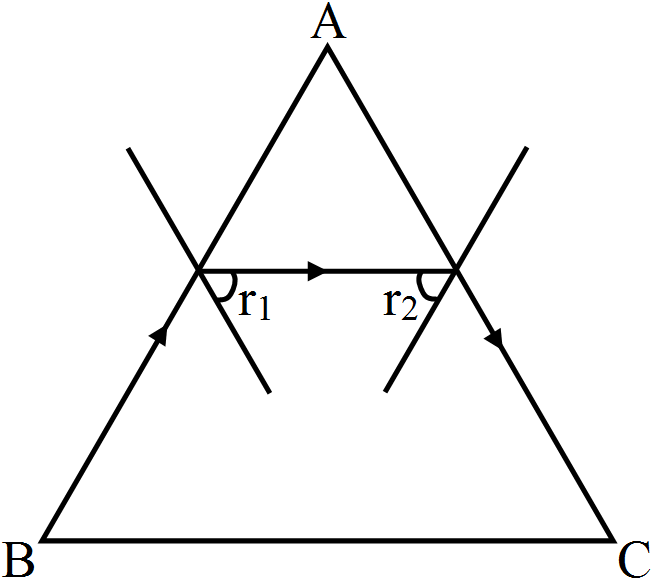
A light ray incident at grazing angle on the face AB of a prism ABC, follows the path shown in the figure. Obtain the relation between the angle of prism A and the refractive index $\mu$ of its material.

A nearsighted person cannot see beyond 25cm. Assuming that the separation of them glass from the eye is 1cm, find the power of lens needed to see distant objects.
A proton and an alpha particle are accelerated through the same potential. Which one of the two has (i) greater value of de-Broglie wavelength associated with it, and (ii) less kinetic energy? Justify your answers.
Establish a relation between resistance and resistivity of any substance. Explain in detail, the dependence of resistivity on the temperature.
A transverse wave of amplitude 0.50mm and frequency 100Hz is produced on a wire stretched to a tension of 100N. If the wave speed is 100m/s, what average power is the source transmitting to the wire?
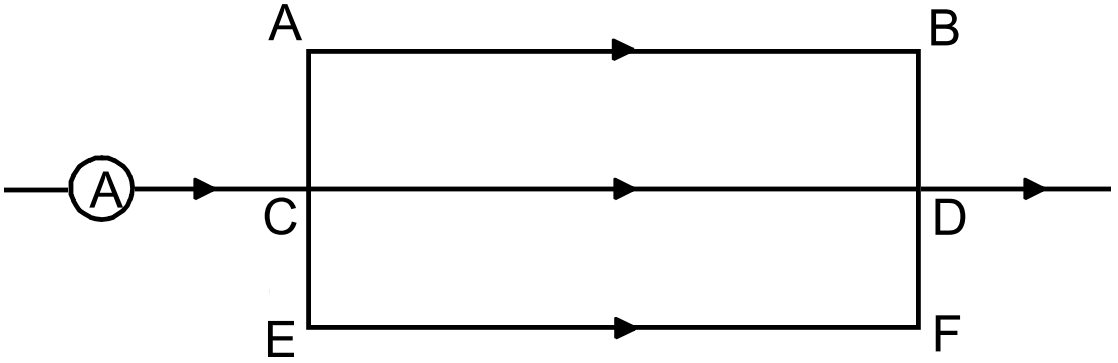
Figure shows a part of an electric circuit. The wires AB, CD and EF are long and have identical resistances. The separation between the neighbouring wires is 1.0cm. The wires AE and BF have negligible resistance and the ammeter reads 30A. Calculate the magnetic force per unit length of AB and CD.