Question
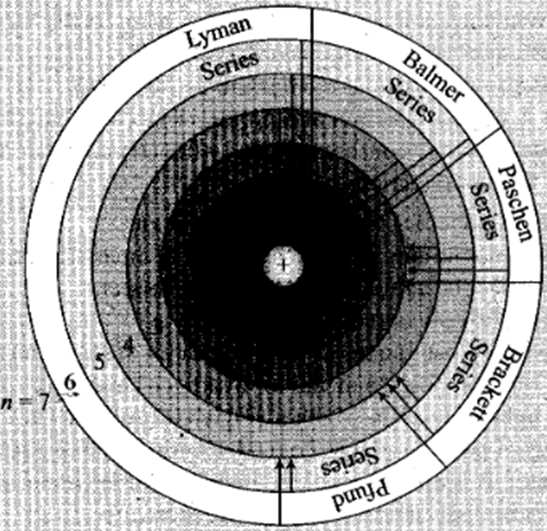
The Balmer series for the $H-$ atom can be observed:
Answer

If we measure the frequencies of light emitted due to transitions between excited states and the first excited state.
A​​​​s a sequence of frequencies with the higher frequencies getting closely packed.
Key concept :
​​​​​​​The vatious lines in the atomic spectra are produced when electrons jump fron higher energy state to a lower energy state and photons are emitted.
These spectral lines are called emission lines.
  1. Mainly there are five series and each series is named after its discoverer as Lyman series, Balmer series, Paschan series, Bracket series and Pfund series.
  2. According to the Bohr's theory the wavelength of the radiations emitted from hydrogen atom is given by
$\frac{1}{\lambda}=\text{R}\bigg[\frac{1}{\text{n}_1^2}-\frac{1}{\text{n}_2^2}\bigg]$
$\Rightarrow\ \lambda=\frac{\text{n}_1^2\text{n}_2^2}{(\text{n}_2^2-\text{n}_1^2)\text{R}}=\frac{\text{n}_1^2}{\Big(1-\frac{\text{n}_1^2}{\text{n}_2^2}\Big)\text{R}}$
where $n_2 =$ outer orbit $($electron jumps from this orbit$), n_1 =$ inner orbit $($electron falls in this orbit$)​​​​​​​$​​​​​​​
  1. First line of the series is called first member, for this lines wavelength is maximum $(\lambda_\text{max})$.
  2. For maximum wavelength if $n_1 = n,$ then $n_2 = n + 1.$
  3. So $\lambda_\text{max}=\frac{\text{n}^2(\text{n}+1)^2}{(2\text{n}+1)\text{R}}$.
  4. Last line of the series is called series limit, for this line wavelength is minimum $(\lambda_\text{max})$.
  5. Foe minimum wavelength $\text{n}_2=\infty,\text{n}_1=\text{n}.\text{ So}\lambda_\text{min}=\frac{\text{n}^2}{\text{R}}.$
  6. The radio of first member and series limit can be calculated as $\frac{\lambda_\text{max}}{\lambda_\text{min}}=\frac{(\text{n}+1)^2}{(2\text{n}+1)}$.
Different spectral series
 
Spectral Series
Transition
$\lambda_\text{max}$
$\lambda_\text{min}$
$\frac{\lambda_\text{max}}{\lambda_\text{min}}$
Region
$1.$
Lyman series
$\text{n}_2=2,3,4 \ ....\infty$
$\text{n}_1=1$
$\frac{4}{3\text{R}}$
$\frac{1}{\text{R}}$
$\frac{4}{3}$
Ultraviolet region
$2.$
Blamer series
$\text{n}_2=3,4,5 \ ....\infty$
$\text{n}_1=2$
$\frac{36}{5\text{R}}$
$\frac{4}{\text{R}}$
$\frac{9}{5}$
Visible region
$3.$
Paschen series
 
$\text{n}_2=4,5,6 \ ....\infty$
$\text{n}_1=3$
$\frac{144}{7\text{R}}$
$\frac{9}{\text{R}}$
$\frac{16}{7}$
Infrared region
$4.$
Bracket series
$\text{n}_2=5,6,7 \ ....\infty$
$\text{n}_1=4$
$\frac{400}{9\text{R}}$
$\frac{16}{\text{R}}$
$\frac{25}{9}$
Infrared region
$5.$
Pfund series
$\text{n}_2=6,7,8 \ ....\infty$
$\text{n}_1=5$
$\frac{900}{11\text{R}}$
$\frac{25}{\text{R}}$
$\frac{36}{11}$
Infrared region
From above discussion we can say Balmer series for the $H-$ atom can be observed if we measure the frequencies of light emitted due to transitions between higher excited states and the first excited state and as a sequence of frequencies with the higher frequencies getting closely packed.

Need a full question paper?

Generate a complete, print-ready paper with questions like this in minutes — across 16+ boards, with answer keys.

Start Generating Free

Similar questions

The electron in a hydrogen atom makes a transition $n _1 \rightarrow n _2$, where $n _1$ and $n _2$ are the principal quantum numbers of the two states. Assume the Bohr model to be valid. The time period of the electron in the initial state is eight times that in the final state. The possible values of $n_1$ and $n_2$ are
Which one is in forward bias
How much energy in kilowatt hour is consumed in operating ten 50 watt bulbs for 10 hours per day in a month (30 days).(a) 1500(b) 5,000(c) 15(d) 150
       
If $\lambda_v, \lambda_{ x }$ and $\lambda_{ m }$ represents wavelengths of visible lights, X-rays and microwaves respectively, then :
A coil develops heat of 800 cal/sec. When 20 volts is applied across its ends. The resistance of the coil is (1 cal = 4.2 joule)(a) 1.2 Ω(b) 1.4 Ω(c) 0.12 Ω(d) 0.14 Ω
       
For making standard resistance, wire of following material is used:
What is the net magnetic flux through a closed surface?
A point object O is placed on the principal axis of a convex lens of focal length f = 20cm at a distance of 40cm to the left of it. The diameter of the lens is 10cm. An eye is placed 60cm to right of the lens and a distance h below the principal axis. The maximum value of h to see the image is:
  1. 0
  2. 2.5cm
  3. 5cm
  4. 10cm.
What is the suitable material for electric fuse?
A steady current $i$ flows in a small square loop of wire of side $L$ in a horizontal plane. The loop is now folded about its middle such that half of it lies in a vertical plane. Let $\overrightarrow{\mu_1}$ and $\overrightarrow{\mu_2}$ respectively denote the magnetic moments due to the current loop before and after folding. Then