MCQ
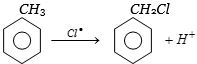
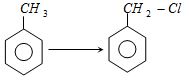
The below Reaction produce through
  • A
    Nucleophilic substitution
  • B
    Electrophilic substitution
  • Free radical substitution
  • D
    More than one of the above processes

Answer

Correct option: C.
Free radical substitution
c
(c) $C{l_2}\xrightarrow{{{\text{Light}}}}2C{l^ \bullet }$

(Freeradical substitution)

Need a full question paper?

Generate a complete, print-ready paper with questions like this in minutes — across 16+ boards, with answer keys.

Start Generating Free

Similar questions

The $IUPAC$ name of $C_6H_5CH=CH-COOH$ is :
Isomerism shown by

$C{H_3} - {(C{H_2})_3} - O - C{H_3}$

$C{H_3} - C{H_2} - O - C{H_2} - C{H_2} - C{H_3}$

$C{H_3} - \mathop {CH}\limits_{\mathop {|\,\,\,\,}\limits_{C{H_3}} } - O - C{H_2} - C{H_3}$   is

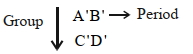
Consider the following elements.

Which of the following is/are true about $\mathrm{A}^{\prime}, \mathrm{B}^{\prime}, \mathrm{C}^{\prime}$ and $\mathrm{D}^{\prime}$ ?

$A$. Order of atomic radii: $\mathrm{B}^{\prime}<\mathrm{A}^{\prime}<\mathrm{D}^{\prime}<\mathrm{C}^{\prime}$

$B$. Order of metallic character: $\mathrm{B}^{\prime}<\mathrm{A}^{\prime}<\mathrm{D}^{\prime}<\mathrm{C}^{\prime}$

$C$. Size of the element : $\mathrm{D}^{\prime}<\mathrm{C}^{\prime}<\mathrm{B}^{\prime}<\mathrm{A}^{\prime}$

$D$. Order of ionic radii : $\mathrm{B}^{\prime+}<\mathrm{A}^{\prime+}<\mathrm{D}^{\prime+}<\mathrm{C}^{\prime+}$

Choose the correct answer from the options given below :
Acidic potassium permanganate/ potassium dichromate oxidises alkenes to produce:
The $IUPAC$ name of $\begin{array}{*{20}{c}}
  {C{H_2} - C = CH - C{H_2}OH} \\ 
  {|\,\,\,\,\,\,\,\,\,\,\,\,\,\,\,\,\,\,|\,\,\,\,\,\,\,\,\,\,\,\,\,\,\,\,\,\,\,\,\,\,\,\,\,\,\,\,\,\,\,\,\,\,\,\,\,\,\,\,\,\,\,\,\,\,\,\,} \\ 
  {\,\,\,\,Cl\,\,\,\,\,\,\,\,\,\,\,\,\,C{H_{3\,\,\,\,\,\,\,\,\,\,\,\,\,\,\,\,\,\,\,\,\,\,\,\,}}\,\,\,\,\,\,\,\,\,\,\,\,\,\,\,\,\,\,\,} 
\end{array}$ is
The energy of the electron at infinite distance from the nucleus in Bohr's Model is taken as
The isomers which can be converted into another forms by rotation of the molecules around single bond are
$IUPAC$ name of succinic acid is 
Most reducing agent is
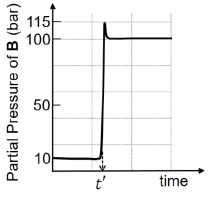
Consider the reaction $A \rightleftharpoons B$ at $1000 K$. At time $t ^{\prime}$, the temperature of the system was increased to $2000 K$ and the system was allowed to reach equilibrium. Throughout this experiment the partial pressure of $A$ was maintained at $1$ bar. Given below is the plot of the partial pressure of B with time. What is the ratio of the standard Gibbs energy of the reaction at $1000 K$ to that at $2000 K$ ?