MCQ
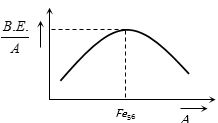
The binding energy per nucleon is maximum in the case of
  • A
    $_4^2He$
  • $_{26}^{56}Fe$
  • C
    $_{56}^{141}Ba$
  • D
    $_{92}^{235}U$

Answer

Correct option: B.
$_{26}^{56}Fe$
b
(b) Binding energy per nucleon increases with atomic number and is maximum for iron. After that it decrease.

Need a full question paper?

Generate a complete, print-ready paper with questions like this in minutes — across 16+ boards, with answer keys.
Start Generating Free

Similar questions

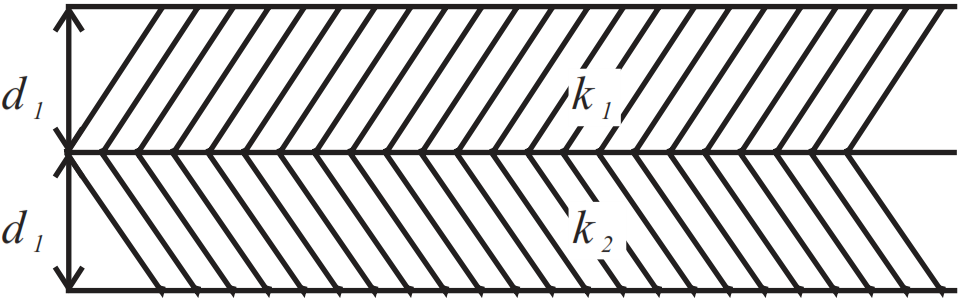
A parallel plate capacitor is made of two dielectric blocks in series. One of the blocks has thickness $d_1$ and dielectric constant $k_1$ and the other has thickness $d_2$ and dielectric constant $k_2$ as shown in Fig.

This arrangement can be thought as a dielectric slab of thickness $d (= d_1 + d_2)$ and effective dielectric constant $k$. The k is
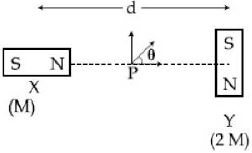
Two magnetic dipoles $X$ and $Y$ are placed at a separation $d$, with their axes perpendicular to each other. The dipole moment of $Y$ is twice that of $X$. A particle of charge $q$ is passing through their mid-point $P$, at angle $\theta  = 45^o$ with the horizontal line as shown in the figure. What would be the magnitude of force on the particle at that instant ? ($d$ is much larger than the dimensions of the dipole)
What is the net magnetic flux through a closed surface?
If the mass number of an atom is A = 40 and its electron configuration is $1 s^2, 2 s^2, 2 p^6, 3 s^2, 3 p^6$ , the number of neutrons and protons in its nucleus will be
In Young's double slit experiment, the distance between sources is 1 mm and distance between the screen and source is 1 m. If the fringe width on the screen is 0.06 cm, then λ =
A hollow metallic sphere of radius $10 \;cm$ is charged such that potential of its surface is $80\; V$. The potential at the centre of the sphere would be
In the circuit as shown in the figure, the heat produced by $6\, ohm$ resistance due to current flowing in it is $60$ calorie per second. The heat generated across $3\, ohm$ resistance per second will be ................. $calorie$
The average power dissipated in a pure inductor of inductance $ L $ when an $ ac $  current is passing through it, is

(Inductance of the coil $ L $ and current $ I $ )

100 mA current gives a full scale deflection in a galvanometer of 2Ω resistance. The resistance connected with the galvanometer to convert it into a voltmeter to measure 5V is
The amplification factor of a triode is $20$ and trans-conductance is $3$ milli mho and load resistance $3 \times {10^4}\Omega $, then the voltage gain is