Question
The binding energy per nucleon of iron atom is approximately.

Answer

The maximum binding energy per nucleon occurs at around mass number $A = 50,$ and corresponds to the most stable nuclei. Iron nucleus $F^{56}$ is located close to the peak with a binding energy per nucleon value of approximately $8.8\ \text{MeV}.$ It’s one of the most stable nuclides that exist.

Need a full question paper?

Generate a complete, print-ready paper with questions like this in minutes — across 16+ boards, with answer keys.
Start Generating Free

Similar questions

Which of the following are insulators.
Which of the following is responsible for the earth’s magnetic field?
Which of the following sources gives best monochromatic light?
A polaroid is placed at $45^{\circ}$ to an incoming light of intensity $\mathrm{I}_0.$ Now the intensity of light passing through polaroid after polarisation would be
The electric field at the origin is along the positive x-axis. A small circle is drawn with the centre at the origin cutting the axes at points A, B, C and D having coordinates (a, 0), (0, a), (-a, 0), (0, -a) respectively. Out of the points on the periphery of the circle, the potential is minimum at.
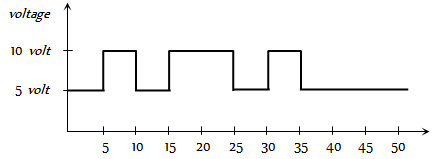
In a negative logic the following wave form corresponds to the
A small coil of $N$ turns has area $A$ and $a$ current $I$ flows through it. The magnetic dipole moment of this coil will be
As the temperature of hot junction of a thermo‑couple is increased (while cold junction is at constant temperature), the thermo e.m.f.(a) Increases uniformly at constant rate(b) Increases slowly in the beginning and more rapidly at higher temperatures(c) Increases more rapidly in the beginning but less rapidly at higher temperatures(d) In minimum at neutral temperature


When a ferromagnetic material goes through a hysteresis loop, the magnetic susceptibility:
  1. Has a fixed value.
  2. May be zero.
  3. May be infinity.
  4. May be negative.
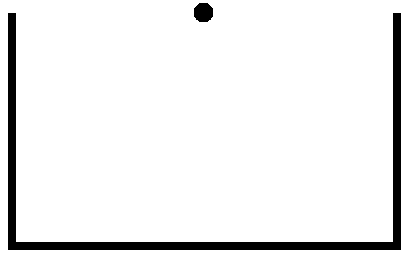
A charge q is placed at the centre of the open end of a cylindrical vessel (figure). The flux of the electric field through the surface of the vessel is:
  1. $\text{Zero}$
  2. $\frac{\text{q}}{\epsilon_0}$
  3. $\frac{\text{q}}{2\epsilon_0}$
  4. $\frac{2\text{q}}{\epsilon_0}$