MCQ
The bisectors of any two adjacent angles of a parallelogram intersect at:
- A$40^\circ$
- B$45^\circ$
- C$60^\circ$
- ✓$90^\circ$
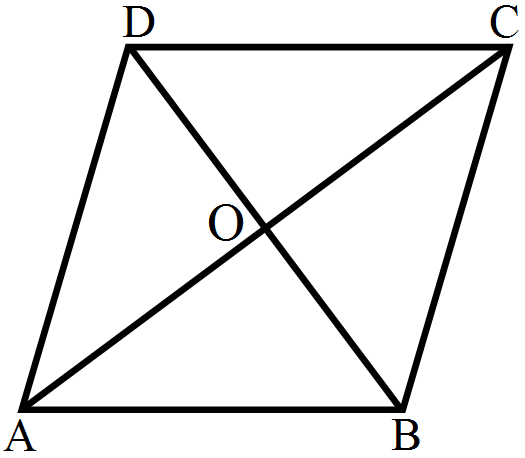
Consider parallelogram $ABCD,$
We know that, the sum if the adjacent angles of a parallelogram is $180^\circ .$
$\Rightarrow\angle\text{DAB}+\angle\text{CBA}=180^{\circ}$
$\Rightarrow\frac{1}{2}\angle\text{DAB}+\frac{1}{2}\angle\text{CBA}=\frac{1}{2}(180^{\circ})$
$\Rightarrow\angle\text{OAB}+\angle\text{OBA}=90^{\circ} ...(\text{i})$
Now,
In $\triangle\text{OAB},$
$\angle\text{OAB}+\angle\text{OBA}+\angle\text{AOB}=180^{\circ}$ ...(Angle sum property)
$\Rightarrow90^{\circ}+\angle\text{AOB}=180^{\circ}$ ...(from $(i))$
$\Rightarrow\angle\text{AOB}=90^{\circ}$
The bisectore of any adjacent angles of a parallelogram intersects at $90^\circ .$
Generate a complete, print-ready paper with questions like this in minutes — across 16+ boards, with answer keys.