MCQ
The bond order is not three for
  • $N_2^ + $
  • B
    $O_2^{2 + }$
  • C
    ${N_2}$
  • D
    $N{O^ + }$

Answer

Correct option: A.
$N_2^ + $
(a) $B.O.$ for $N_2^ + $ =$\frac{1}{2}[{N_b} - {N_a}]$

=$\frac{1}{2}[9 - 4] = \frac{5}{2} = 2.5$.

Need a full question paper?

Generate a complete, print-ready paper with questions like this in minutes — across 16+ boards, with answer keys.

Start Generating Free

Similar questions

Decarboxylation of all six possible forms of diaminobenzoic acids $C _{6} H _{3}\left( NH _{2}\right)_{2} COOH$ yields three products $A , B$ and $C$. Three acids give a product $'A',$ two acids gives a product $'B'$ and one acid give a product $'C'.$ The melting point of product $'C'$ is .....$^{\circ} C$.
Which of the following is a low-spin complex?
Given below are two statements. One is labelled as Assertion A and the other is labelled as Reason $R$.

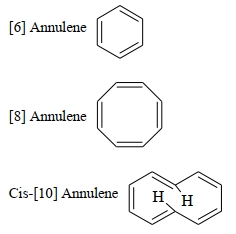
Assertion $A$ :$[6]$ Annulene.$[8]$ Annulene and cis - $[10]$ Annulene, are respectively aromatic, not-aromatic and aromatic.

Reason $R$ : Planarity is one of the requirements of aromatic systems.

In the light of the above statements, choose the most appropriate answer from the options given below.
For reaction : $SO _2( g )+\frac{1}{2} O _2( g ) \rightleftharpoons SO _3( g )$ $K _{ P }=2 \times 10^{12}$ at $27^{\circ}\,C$ and 1 atm pressure. The $K _{ c }$ for the same reaction is $.........\times 10^{13}$. (Nearest integer)

(Given $R =0.082\,L\,atm\,K ^{-1}\,mol ^{-1}$ )

When benzene diazonium chloride treated with $\beta -$ naphthol in alkaline medium a coupling reaction takes place and result into formation of azodye. In this reaction benzene diazonium chloride act as
Suppose that an alkaline dry cell was manufactured using cadmium metal rather than $Zn$ . What effect would this have on the standard emf of the cell. The standard reduction potential $E_{C{d^{2 + }}/Cd}^o =  - 0.40\,V$ 

while $E_{Z{n^{2 + }}/Zn}^o =  - 0.76\,V$
Find out the incorrect statement
In which of the following ${S_{{N^1}}}$ reaction racemic mixture will form as major product ?
Which one of the following sets of quantum numbers represents an impossible arrangement?
Which is the correct order of electronegativities