MCQ
The bonds between $P$ atoms and $Cl$ atoms in $PCl_5$ are likely to be
- AIonic with non covalent character
- ✓Covalent with some ionic character
- CCovalent with no ionic character
- DIonic with some metallic character
Generate a complete, print-ready paper with questions like this in minutes — across 16+ boards, with answer keys.
$ Given\, :\, lna = 2.3\, loga$
| Catalyst | Process |
| $(i) \;\mathrm{Na}_{2} \mathrm{O}$ | $(a)$ The oxidation of ethyne to ethanal |
| $(ii) \;\mathrm{TiCl}_{4}+ \mathrm{Al(CH_3)}_{3}$ | $(b)$ Polymerisation of alkynes |
|
$(iii)\;\mathrm{PdCl_2} $ |
$(c)$ Oxidation of $SO_2$ in the manufacture of $H_2SO_4$ |
| $(iv)\;$Nickel complexes | $(d)$ Polymerisation of ethylene |
Which of the following is the correct option ?
$\underset{(1)}{\mathop{C{{H}_{3}}C{{H}_{2}}CHO}}\,$
$\underset{(2)}{\mathop{\begin{matrix}
O \\
|| \\
C{{H}_{3}}-C-C{{H}_{3}} \\
\end{matrix}}}\,$
$\underset{(3)}{\mathop{C{{H}_{3}}-CH=CH-OH}}\,$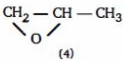
$A.$ Surface tension is the outcome of equal attractive and repulsion forces acting on the liquid molecule in bulk.
$B.$ Surface tension is due to uneven forces acting on the molecules present on the surface.
$C.$ The molecule in the bulk can never come to the liquid surface.
$D.$ The molecules on the surface are responsible for vapour pressure if the system is a closed system.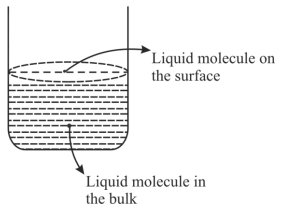
$(i)\,2Fe(s)\, + \,\frac{3}{2}\,{O_2}\,(g)\, \to \,F{e_2}{O_3}\,(s)\,;$ $\Delta {H^\Theta }\, = \ \,-193.4\,kJ$
$(ii)\,Mg(s)\, + \,\,{O_2}\,(g)\, \to \,MgO\,(s)\,;$ $\Delta {H^\Theta }\, = \, - \,140.2\,kJ$
What is $\Delta {H^\Theta }$ of the reaction ?
$3Mg + Fe_2O_3 \to 3MgO + 2Fe$
.......$kJ$