The breaking stress of a wire of length $L$ and radius $r$ is $5$ $kg - wt/{m^2}$. The wire of length $2l$ and radius $2r$ of the same material will have breaking stress in $kg - wt/{m^2}$
Easy


Download our appand get started for free
Experience the future of education. Simply download our apps or reach out to us for more information. Let's shape the future of learning together!No signup needed.*
Similar Questions
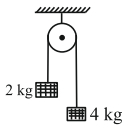
- 1Two blocks of mass $2 \mathrm{~kg}$ and $4 \mathrm{~kg}$ are connected by a metal wire going over a smooth pulley as shown in figure. The radius of wire is $4.0 \times 10^{-5}$ $\mathrm{m}$ and Young's modulus of the metal is $2.0 \times 10^{11} \mathrm{~N} / \mathrm{m}^2$. The longitudinal strain developed in the wire is $\frac{1}{\alpha \pi}$. The value of $\alpha$ is [Use $\mathrm{g}=10 \mathrm{~m} / \mathrm{s}^2$ )View Solution
- 2The diameter of a brass rod is 4 mm and Young's modulus of brass is $9 \times {10^{10}}\,N/{m^2}$. The force required to stretch by $0.1\%$ of its length isView Solution
- 3The bulk moduli of ethanol, mercury and water are given as $0.9, 25$ and $2 .2$ respectively in units of $10^9\, Nm^{-2}$ . For a given value of pressure, the fractional compression in volume is $\frac{{\Delta V}}{V}$. Which of the following statements about $\frac{{\Delta V}}{V}$ for these three liquids is correct ?View Solution
- 4A metal wire of length $'L'$ is suspended vertically from a rigid support. When a body of mass $M$ is attached to the lower end of wire, the elongation in wire is $'l'$, consider the following statementsView Solution
$(I)$ the loss of gravitational potential energy of mass $M$ is $Mgl$
$(II)$ the elastic potential energy stored in the wire is $Mgl$
$(III)$ the elastic potential energy stored in wire is $\frac{1}{2}\, Mg l$
$(IV)$ heat produced is $\frac{1}{2}\, Mg l$
Correct statement are :-
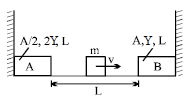
- 5In the given figure, two elastic rods $A$ & $B$ are rigidly joined to end supports. $A$ small mass $‘m’$ is moving with velocity $v$ between the rods. All collisions are assumed to be elastic & the surface is given to be frictionless. The time period of small mass $‘m’$ will be : [$A=$ area of cross section, $Y =$ Young’s modulus, $L=$ length of each rod ; here, an elastic rod may be treated as a spring of spring constant $\frac{{YA}}{L}$ ]View Solution
- 6The bulk modulus of rubber is $9.1\times 10^8\,N/m^2$. To ......... $m$ depth a rubber ball be taken in a lake so that its volume is decreased by $0.1\,\%$ .View Solution
- 7A rigid bar of mass $15\,kg$ is supported symmetrically by three wire each of $2 \,m$ long. These at each end are of copper and middle one is of steel. Young's modulus of elasticity for copper and steel are $110 \times 10^9 \,N / m ^2$ and $190 \times 10^9 \,N / m ^2$ respectively. If each wire is to have same tension, ratio of their diameters will be $ ............$View Solution
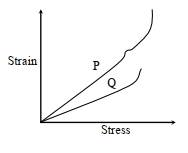
- 8In plotting stress versus strain curves for two materials $P$ and $Q$, a student by mistake puts strain on the $y$-axis and stress on the $x$-axis as shown in the figure. Then the correct statement$(s)$ is(are)View Solution
$(A)$ $P$ has more tensile strength than $Q$
$(B)$ $P$ is more ductile than $Q$
$(C)$ $P$ is more brittle than $Q$
$(D)$ The Young's modulus of $P$ is more than that of $Q$
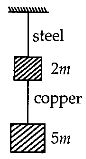
- 9If the ratio of diameters, lengths and Young's modulus of steel and copper wires shown in the figure are $p, q$ and $s$ respectively, then the corresponding ratio of increase in their lengths would beView Solution
- 10View SolutionWhich is correct relation