MCQ
The capacitance of a parallel plate condenser does not depend on
  • A
    Area of the plates
  • B
    Medium between the plates
  • C
    Distance between the plates
  • Metal of the plates

Answer

Correct option: D.
Metal of the plates
d
Formula used

capacitance $c=\frac{q}{v}$

capacitance of a parallel plate capacitor is given as

$c=\frac{k \varepsilon_0 A}{d}$

The capacitance of the condensor does not depend upon metal of the plates

Need a full question paper?

Generate a complete, print-ready paper with questions like this in minutes — across 16+ boards, with answer keys.
Start Generating Free

Similar questions

The potential energy of a particle of mass $100 \,g$ moving along $x$-axis is given by $U=5 x(x-4)$, where $x$ is in metre. The period of oscillation is .................
The energy that will be ideally radiated by a $100\,kW$ transmitter in $1$ hour is :
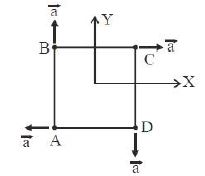
Four particles $A, B, C$ and $D$ with masses $m_A=m, m_B=2m, m_C=3m$ and $m_D=4m$ are at the corners of a square. They have accelerations of equal magnitude with directions as shown. The acceleration of the centre of mass of the particles is
In the following reaction the value of $‘X’$ is $_7{N^{14}}{ + _2}H{e^4}\, \to \,X{ + _1}{H^1}$
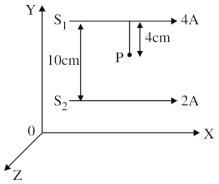
Two long parallel conductors $S_{1}$ and $S_{2}$ are separated by a distance $10 \,cm$ and carrying currents of $4\, A$ and $2 \,A$ respectively. The conductors are placed along $x$-axis in $X - Y$ plane. There is a point $P$ located between the conductors (as shown in figure).

A charge particle of $3 \pi$ coulomb is passing through the point $P$ with velocity

$\overrightarrow{ v }=(2 \hat{ i }+3 \hat{ j }) \,m / s$; where $\hat{i}$ and $\hat{j} \quad$ represents unit vector along $x$ and $y$ axis respectively.

The force acting on the charge particle is $4 \pi \times 10^{-5}(-x \hat{i}+2 \hat{j}) \,N$. The value of $x$ is
Star $A$ has radius $ r$ surface temperature $T$ while star $B$ has radius $4r$ and surface temperature $T/2$ . The ratio of the power of two starts, $P_A : P_B$ is
In the resonance tube experiment, first resonant length is $l_1$ and second  resonant length is $l_2$ then the third resonant length will be
If ${N_0}$ is the original mass of the substance of half life period ${T_{1/2}} = 5$ years, then the amount of substance left after $15$ years is
For a solenoid keeping the turn density constant its length is halved and its cross section radius is doubled then the inductance of the solenoid increased by.....$\%$
The speed of sound in oxygen $\left( O _{2}\right)$ at a certain temperature is $460 \;ms ^{-1}$. The speed of sound in helium $(He)$ at the same temperature will be (asume both gases to be ideal)