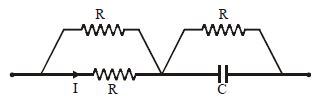
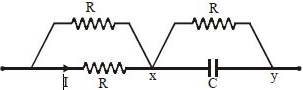
The capacitor shown in fig. is in steady state. The energy stored in the capacitor is
Medium


Download our appand get started for free
Experience the future of education. Simply download our apps or reach out to us for more information. Let's shape the future of learning together!No signup needed.*
Similar Questions
- 1In the circuit shown in the figure, the current flowing in $2\,\Omega $ resistance ............... $A$View Solution
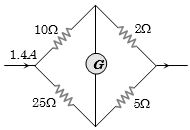
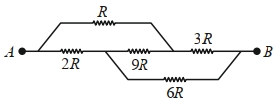
- 2The equivalent resistance between $A$ and $B$ of the network shown in figureView Solution
- 3View SolutionWhich of the following has a negative temperature coefficient
- 4A potentiometer wire of length $1\,m$ and resistance $10\,\Omega$ is connected in series with a cell of $emf$ $2\,V$ with internal resistance $1 \,\Omega$ and a resistance box including a resistance $R$. If potential difference between the ends of the wire is $1\, mV$, the value of $R$ is ............. $\Omega $View Solution
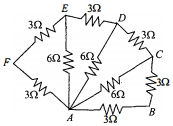
- 5Six resistors of $3 \;\Omega$ each are connected along the sides of a hexagon and three resistors of $6\; \Omega$ each are connected along $A C, A D$ and $A E$ as shown in the figure. The equivalent resistance between $A$ and $B$ is equal toView Solution
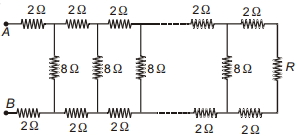
- 6Consider the ladder network shown in figure. What should be the value of resistance $R$, so that effective resistance between $A$ and $B$ becomes independent of number of elements in the combination is ............. $\Omega$View Solution
- 7View SolutionWhen electric bulbs of same power, but different marked voltage are connected in series across the power line, their brightness will be :
- 8Two electric bulbs $A$ and $B$ are rated as $60\, W$ and $100\, W$. They are connected in parallel to the same source. Then,View Solution
- 9A cable of resistance $10\,\Omega $ carries electric power from a generator producing $250\, kW$ at $10000\, volt$, the power lost in the cable during transmission is ............. $kW$View Solution
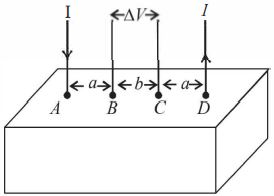
- 10Consider a block of conducting material ofresistivity '$\rho$' shown in the figure. Current '$I$' enters at '$A$' and leaves from '$D$'. We apply superp osition principle to find voltage '$\Delta V$ ' developed between '$B$' and '$C$'. The calculation is done in the following steps:View Solution
$(i)$ Take current '$I$' entering from '$A$' and assume it to spread over a hemispherical surface in the block.
$(ii)$ Calculatefield $E(r)$ at distance '$r$' from $A$ by using Ohm's law $E = \rho j$, where j is the current per unit area at '$r$'.
(iii) From the '$r$' dependence of $E(r)$, obtain the potential $V(r)$ at $r$.
(iv) Repeat $(i), (ii)$ and $(iii)$ for current '$I$' leaving '$D$' and superpose results for '$A$' and '$D$'.$\Delta V$ measured between $B$ and $C$ is