MCQ
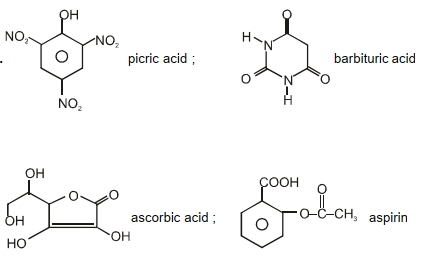
The carboxyl functional group $(- COOH )$ is present in
- Apicric acid
- Bbarbituric acid
- Cascorbic acid
- ✓aspirin
Generate a complete, print-ready paper with questions like this in minutes — across 16+ boards, with answer keys.
$\mathrm{A}+\mathrm{B} \rightarrow \mathrm{C}$
$\text { rate }=\mathrm{k}[\mathrm{A}]^{1 / 2}[\mathrm{~B}]^{1 / 2}$
The reaction is initiated by taking $1 \mathrm{M}$ concentration $A$ and $B$ each. If the rate constant $(k)$ is $4.6 \times 10^{-2} \mathrm{~s}^{-1}$, then the time taken for $\mathrm{A}$ to become $0.1 \mathrm{M}$ is . . . . . . . . . . sec. (nearest integer)
$(A)$ Total number of valence shell electrons at metal centre in $Fe ( CO )_5$ or $Ni ( CO )_4$ is $16$
$(B)$ These are predominantly low spin in nature
$(C)$ Metal-carbon bond strengthens when the oxidation state of the metal is lowered
$(D)$ The carbonyl $C - O$ bond weakens when the oxidation state of the metal is increased
$\mathrm{A}+\mathrm{B} \underset{\text { Step } 3}{\text { Step } 1} \mathrm{C} \xrightarrow{\text { Step } 2} \mathrm{P}$
Some details of the above reaction are listed below.
| Step |
Rate constant $\left(\sec ^{-1}\right)$ |
Activation energy $\left(\mathrm{kJ} \mathrm{mol}^{-1}\right)$ |
| $1$ | ${k}_1$ | $300$ |
| $2$ | ${k}_2$ | $200$ |
| $3$ | ${k}_3$ | $\mathrm{Ea}_3$ |
If the overall rate constant of the above transformation (k) is given as $\mathrm{k}=\frac{\mathrm{k}_1 \mathrm{k}_2}{\mathrm{k}_3}$ and the overall activation energy $\left(E_2\right)$ is $400 \mathrm{~kJ} \mathrm{~mol}^{-1}$, then the value of $\mathrm{Ea}_3$ is $\qquad$ $\mathrm{kJ} \mathrm{mol}^{-1}$ (nearest integer)