Question
The cells derived from cambium, root apical and shoot apical meristem differentiate and mature to perform specific functions. This act is called

Answer

a
Growth is invariably associated with differentiation. For example, when a seed germinates it does not simply increases in size but form seedlings. Differentiation is a permanent, localised qualitative change in size, biochemistry, structure and function of cells, tissues or organs, $e \cdot g .$, fibres, vessels, tracheids, sieve tubes, mesophyll, leaf, etc.

Need a full question paper?

Generate a complete, print-ready paper with questions like this in minutes — across 16+ boards, with answer keys.

Start Generating Free

Similar questions

In agarose gel electrophoresis, $DNA$ molecules are separated on the basis of their
$PS-I$ in cyclic photophosphorylation is involved in the formation of ...$A$... by ...$B$... movement of electrons

What does $A$ and $B$ refer here?

Match List $I$ with List $II$ :

List $I$ List $II$
$A$. Oxidative decarboxylation $I$. Citrate synthase
$B$. Glycolysis $II$. Pyruvate dehydrogenase
$C$. Oxidative phosphorylation $III$. Electron transport system
$D$. Tricarboxylic acid cycle $IV$. $EMP$ pathway

Choose the correct answer from the options given below :
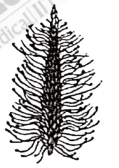
In Pinus, male cone bears a large number of
Identify the correct description about the given figure:
Which of the following statements are false?

$I$. Insulin for curing diabetes, used to be extracted from the pancreas of slaughtered pig and cattle

$II$. Animal insulin is slighty different from the human insulin

$III$. Animal insulin causes some undesirable side effects such as allergy

$IV$. Bacteria cannot be made to synthesise insulin from its gene because of the presence of introns

Choose the correct option
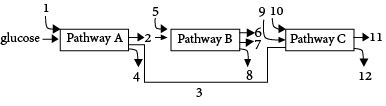
The three boxes in this diagram represent the three major biosynthetic pathways in aerobic respiration. Arrows represent net reactants or products.Arrows numbered $4, 8$ and $12$ can all be
Oxygen is $not$ produced during photosynthesis by
Golden rice is a genetically modified crop plant where the incorporated gene is meant for biosynthesis of
Today, transgenic models have been developed for many human diseases, which includes

$I$. rheumatoid arthritis $II$. Alzheimer's disease

$III$ cancer $IV$. Cystic fibrosis

Choose the correct option