MCQ
The characteristic $X-$ ray radiation is emitted, when
  • A
    The electrons are accelerated to a fixed energy
  • B
    The source of electrons emits a monoenergetic beam
  • The bombarding electrons knock out electrons from the inner shell of the target atoms and one of the outer electrons falls into this vacancy
  • D
    The valence electrons in the target atoms are removed as a result of the collision
Answer

Correct option: C.
The bombarding electrons knock out electrons from the inner shell of the target atoms and one of the outer electrons falls into this vacancy
c
The characteristic $X-$ray radiation is emitted, when the bombarding electrons knock out electrons from the inner shell of the target atoms and one of the outer electrons falls into this vacancy.

Need a full question paper?

Generate a complete, print-ready paper with questions like this in minutes — across 16+ boards, with answer keys.

Start Generating Free

Similar questions

A circular coil of radius $5\, cm$ has $500$ turns of a wire. The approximate value of the coefficient of self induction of the coil will be
A photon in motion has a mass
Force on current carrying loop (Radius $= R$ ) in uniform magnetic $(B)$ field which is at an angle $30^{\circ}$ with the normal will be
The capacity of an air condenser is 2.0 mF. If a medium is placed between its plates. The capacity becomes 12 mF. The dielectric constant of the medium will be
The ratio of gravitational force and electrostatic repulsive force between two electrons is approximately (gravitational constant $=6.7 \times 10^{-11} \,Nm ^2 / kg ^2$, mass of an electron $=9.1 \times 10^{-31} \,kg$, charge on an electron $=1.6 \times 10^{-19} C$ )
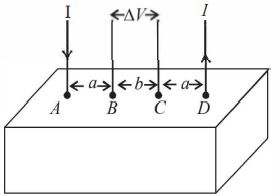
Consider a block of conducting material ofresistivity '$\rho$' shown in the figure. Current '$I$' enters at '$A$' and leaves from '$D$'. We apply superp osition principle to find voltage '$\Delta  V$ ' developed between '$B$' and '$C$'. The calculation is done in the following steps:
$(i)$ Take current '$I$' entering from '$A$' and assume it to spread over a hemispherical surface in the block.
$(ii)$ Calculatefield $E(r)$ at distance '$r$' from $A$ by using Ohm's law $E = \rho  j$, where j is the current per unit area at '$r$'.
$(iii)$ From the '$r$' dependence of $E(r)$, obtain the potential $V(r)$ at $r$.
$(iv)$ Repeat $(i), (ii)$ and $(iii)$ for current '$I$' leaving '$D$' and superpose results for '$A$' and '$D$'.

For current entering at $A$, the electric field at a distance '$r$'
from $A$ is

A radioactive material of half-life $T$ was produced in a nuclear reactor at different instants, the quantity produced second time was twice of that produced first time. If now their present activities are $A_1$ and $A_2$ respectively then their age difference equals :
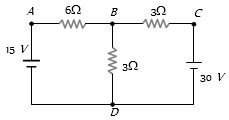
In the circuit shown in figure, find the current through the branch $BD$ ............. $A$
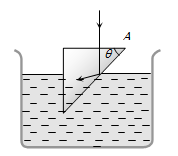
The refractive index of the material of the prism and liquid are 1.56 and 1.32 respectively. What will be the value of q for the following refraction
Point charges $ + 4q,\, - q$ and $ + 4q$ are kept on the $x - $axis at points $x = 0,\,x = a$ and $x = 2a$ respectively, then