MCQ
The charcoal maintained at ${100^o}\,C$ absorbs
- A$Ne$ and $Kr$
- B$He$ and $Ar$
- ✓$Ar,$ $Kr,$ $Xe$
- D$He$ and $Ne$
Generate a complete, print-ready paper with questions like this in minutes — across 16+ boards, with answer keys.
$\begin{array}{*{20}{c}}
{C{H_3}CH = C{H_2} + {H_2}O\overset {{H^ + }} \longleftrightarrow C{H_3} - CH - C{H_3}} \\
{\,\,\,\,\,\,\,\,\,\,\,\,\,\,\,\,\,\,\,\,\,\,\,\,\,\,\,\,\,\,\,\,\,\,\,\,\,\,\,\,\,\,\,\,\,\,\,\,\,\,\,\,\,\,\,\,\,\,\,\,\,\,\,\,\,\,\,\,\,|} \\
{\,\,\,\,\,\,\,\,\,\,\,\,\,\,\,\,\,\,\,\,\,\,\,\,\,\,\,\,\,\,\,\,\,\,\,\,\,\,\,\,\,\,\,\,\,\,\,\,\,\,\,\,\,\,\,\,\,\,\,\,\,\,\,\,\,\,\,\,\,\,\,\,\,\,\,OH}
\end{array}$
The reaction takes place in accordance with
Statement $I$ : The rate law for the reaction $A+B \rightarrow C$ is rate $(r)=k[A]^2[B]$. When the concentration of both $\mathrm{A}$ and $\mathrm{B}$ is doubled, the reaction rate is increased " $\mathrm{x}$ " times.
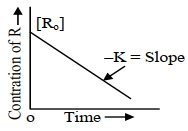
Statement $II$ :
(Image)
The figure is showing "the variation in concentration against time plot" for a $"y"$ order reaction. The value of $x+y$ is . . . . . .