The charge given to a hollow sphere of radius $10\, cm$ is $3.2×10^{-19}\, coulomb$. At a distance of $4\, cm$ from its centre, the electric potential will be
Easy


Download our appand get started for free
Experience the future of education. Simply download our apps or reach out to us for more information. Let's shape the future of learning together!No signup needed.*
Similar Questions
- 1The potential function of an electrostatic field is given by $V = 2x^2$. Determine the electric field strength at the point $(2\,m, 0, 3\,m)$View Solution
- 2What is the potential energy of the equal positive point charges of $1\,\mu C$ each held $1\, m$ apart in airView Solution
- 3View SolutionIn the transient shown the time constant of the circuit is :
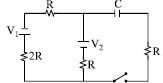
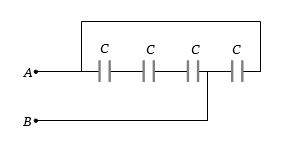
- 4The equivalent capacitance between $A$ and $B$ isView Solution
- 5The variation of electrostatic potential with radial distance $r$ from the centre of a positively charged metallic thin shell of radius $R$ is given by the graphView Solution
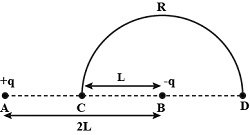
- 6Charges $+q$ and $-q$ are placed at points $A$ and $B$ respectively which are a distance $2\,L$ apart, $C$ is the midpoint between $A$ and $B.$ The work done in moving a charge $+Q$ along the semicircle $CRD$ isView Solution
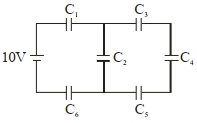
- 7In the given circuit, $C _1=2\,\mu F , C _2=0.2\,\mu F$, $C _3=2\,\mu F , C _4=4\,\mu F,$ $C _5=2\,\mu F , C _6=2\,\mu F$, the charge stored on capacitor $C _4$ is $.....\mu C$.View Solution
- 8At distance of $5$ $cm$ and $10$ $cm $ outwards from the surface of a uniformly charged solid sphere, the potentials are $100$ $V$ and $75$ $V$ respectively . ThenView Solution
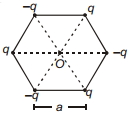
- 9Six point charges are placed at the vertices of a regular hexagon of side $a$ as shown. If $E$ represents electric field and $V$ represents electric potential at $O$, thenView Solution
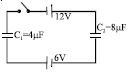
- 10In the circuit shown initially $C_1, C_2$ are uncharged. After closing the switchView Solution