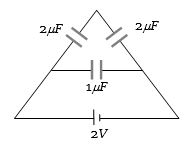
The charge on any one of the $2\,\mu \,F$ capacitors and $1\,\mu \,F$ capacitor will be given respectively (in $\mu \,C$) as
Easy
Download our app for free and get started
(d) Potential difference across both the lines is same i.e. $2\, V$. Hence charge flowing in line $2$
$Q = \left( {\frac{2}{2}} \right) \times 2 = 2\,\mu C$ So charge on each capacitor in line $(2)$ is $2\, µC$
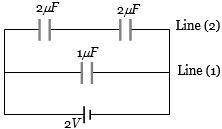
$Q = \left( {\frac{2}{2}} \right) \times 2 = 2\,\mu C$ So charge on each capacitor in line $(2)$ is $2\, µC$

Download our appand get started for free
Experience the future of education. Simply download our apps or reach out to us for more information. Let's shape the future of learning together!No signup needed.*
Similar Questions
- 1View SolutionA battery is used to charge a parallel plate capacitor till the potential difference between the plates becomes equal to the electromotive force of the battery. The ratio of the energy stored in the capacitor and the work done by the battery will be
- 2View SolutionThe capacity of a parallel plate capacitor increases with the
- 3Two charged parallel plate capacitors, each with separation between plates equal to $d$, are separated by a large distance $L >> d$. Then the force of interaction between them is proportional toView Solution
- 4Two insulated charged spheres of radii $20\,cm$ and $25\,cm$ respectively and having an equal charge $Q$ are connected by a copper wire, then they are separatedView Solution
- 5A parallel plate capacitor is made of two circular plates separated by a distance $5\ mm$ and with a dielectric of dielectric constant $2.2$ between them. When the electric field in the dielectric is $3 \times 10^4$ $ Vm^{-1}$ the charge density of the positive plate will be close toView Solution
- 6The parallel combination of two air filled parallel plate capacitors of capacitance $C$ and $nC$ is connected to a battery of voltage, $V$. When the capacitor are fully charged, the battery is removed and after that a dielectric material of dielectric constant $K$ is placed between the two plates of the first capacitor. The new potential difference of the combined system isView Solution
- 7View SolutionA conductor with a positive charge
- 8View SolutionThe separation between the plates of a isolated charged parallel plate capacitor is increased. Which of the following quantities will change?
- 9The electric potential at a point in free space due to charge $Q$ coulomb is $V=Q$$ \times {10^{11}}\,V$ . The electric field at that point isView Solution
- 10A capacitor of capacity $C$ is charged to a steady potential difference $V$ and connected in series with an open key and a pure resistor $'R'$. At time $t = 0$, the key is closed. If $I =$ current at time $t$, a plot of log $I$ against $'t'$ is as shown in $(1)$ in the graph. Later one of the parameters i.e. $V, R$ or $C$ is changed keeping the other two constant, and the graph $(2)$ is recorded. ThenView Solution