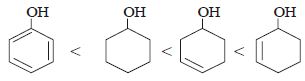
MCQ
The Clemmenson reduction of acetone yields
- AEthanol
- BEthanal
- ✓Propane
- DPropanol
Generate a complete, print-ready paper with questions like this in minutes — across 16+ boards, with answer keys.
$\begin{array}{*{20}{c}} {\,\,\,\,\,\,\,\,\,\,\,\,\,\,\,\,\,\,\,\,\,\,\,\,\,\,\,\,\,\,\,\,OH} \\ {\,\,\,\,\,\,\,\,\,\,\,\,\,\,\,\,\,\,\,\,\,\,\,\,\,\,\,|} \\ {( \pm )\,\,C{H_3} - C{H_2} - CH - C{H_3}} \end{array}$ $\xrightarrow[\Delta ]{{{H_3}P{O_4}}}P\,\xrightarrow[{Ni}]{{{D_2}}}Q$
$Cu ( s )+ Sn ^{2+}( aq ) \rightarrow Cu ^{2+}( aq )+ Sn ( s )$
$\left( E _{ Sn ^{2+} \mid Sn }^{0}=-0.16\, V , E _{ Cu ^{2+} \mid Cu }^{0}=0.34\, V \right.$ Take $F=96500\, C\, mol ^{-1}$ )

$C{H_3} - \mathop {\mathop {\mathop {\mathop C\limits^| }\limits^{Cl} - }\limits_{|\,\,\,\,} }\limits_{OH} C{H_2}CH = CHC{H_3}$
Reason : Alcohols leading to conjugated alkenes are dehydrated to a greater extent