Question
The coefficient of mutual inductance between two coils depends on.

Answer

  1. all of the above
Explanation:
The flux linked with two coils will depend upon the angle between the two coils. If their planes are parallel, then magnetic flux from one would completely pass through the other. If the planes are perpendicular, no flux due to any of the coils would flow through the other.
The size of the two coils may be different which will affect the number of lines crossing the coil. The medium, if magnetic, will concentrate the field lines. Thus, all parameters would affect the inductance between them.


Need a full question paper?

Generate a complete, print-ready paper with questions like this in minutes — across 16+ boards, with answer keys.
Start Generating Free

Similar questions

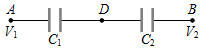
Two condensers $C _1$ and $C _2$ in a circuit are joined as shown in figure. The potential of point $A$ is $V _1$ and that of B is $V _2$. The potential of point $D$ will be
Two identical heaters rated 220 volt, 1000 watt are placed in series with each other across 220 volt lines. If resistance do not change with temperature, then the combined power is(a) 1000 watt(b) 2000 watt(c) 500 watt(d) 4000 watt
       
Use of eddy currents is done in the following except(a)  Moving coil galvanometer(b)  Electric brakes(c)  Induction motor(d)  Dynamo
   
   
When an ammeter is shunted its measuring range :
The half$-$life of a radioactive substance against $a-$decay is $1.2 \times 10^7 s.$ What is the decay rate for $4 \times 10^{15}$  atoms of the substance
Consider a sample of a pure beta-active material:
  1. All the beta particles emitted have the same energy.
  2. The beta particles originally exist inside the nucleus and are ejected at the time of beta decay.
  3. The antineutrino emitted in a beta decay has zero mass and hence zero momentum.
  4. The active nucleus changes to one of its isobars after the beta decay.
(USS 133) Indium impurity in germanium makes(a) N-type(b) P-type(c) Insulator(d) Intrinsic
       
Resistance of tungsten wire at 150℃  is 133 Ω . Its resistance temperature coefficient is 0.0045/℃. The resistance of this wire at 500 ℃  will be(a) 180 Ω(b) 225 Ω(c) 258 Ω(d) 317 Ω
       
Domain formation is the necessary feature of:
The mutual characteristic of triode is