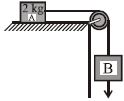
The coefficient of static friction, $\mu _s$ between block $A$ of mass $2\,kg$ and the table as shown in the figure is $0.2$. What would be the maximum mass value of block $B$ so that the two blocks $B$ so that the two blocks do not move? The string and the pulley are assumed to be smooth and masseless ....... $kg$ $(g = 10\,m/s^2)$
Medium
Download our app for free and get started
Let the mass of the block $B$ is $M$.
In equilibrium of block $B$ implies $T=M g \ldots(i)$
If block $A$ does not move, then $T=f_{s}$
where $f_{s}=$ frictional force $=\mu_{S} N=\mu_{s} m g$
implies $T=\mu_{s} m g \ldots(i i)$
Thus, from Eqs. $( i )$ and $(ii),$ we have
$M=\mu_{s} m g$ or $M=\mu_{s} m$
Given: $\mu_{s}=0.2, m=2 k g$
$\therefore M=0.2 \times 2=0.4 k g$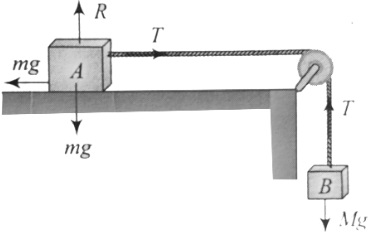

Download our appand get started for free
Experience the future of education. Simply download our apps or reach out to us for more information. Let's shape the future of learning together!No signup needed.*
Similar Questions
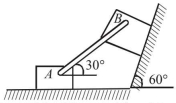
- 1In figure, two blocks are separated by a uniform strut attached to each block with frictionless pins. Block $A$ weighs $400\,N$, block $B$ weighs $300\,N$, and the strut $A B$ weigh $200\,N$. If $\mu=0.25$ under $B$, determine the minimum coefficient of friction under $A$ to prevent motion.View Solution
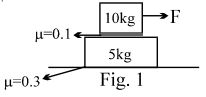
- 2The maximum acceleration of $5\, kg$ block ...... $m/s^2$View Solution
- 3$A$ block of mass $M$ is placed on $a$ horizontal surface and it is tied with an inextensible string to $a$ block of mass, as shown in figure. A block of mass $m_0$ is also placed on $M$ If friction force exists between the block $M$ and the block $m_0$ and not between the block $M$ and the horizontal surface, then the minimum value of $\mu$ for which the block m remains stationary isView Solution

- 4View SolutionA body is revolving with a constant speed along a circle. If its direction of motion is reversed but the speed remains the same, then which of the following statement is true
- 5A car of $800 \mathrm{~kg}$ is taking turn on a banked road of radius $300 \mathrm{~m}$ and angle of banking $30^{\circ}$. If coefficient of static friction is $0.2$ then the maximum speed with which car can negotiate the turn safely : $\left(\mathrm{g}=10 \mathrm{~m} / \mathrm{s}^2, \sqrt{3}=1.73\right)$View Solution
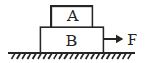
- 6In figure, the coefficient of friction between the floor and the block $B$ is $0.1$. The coefficient of friction between the blocks $B$ and $A$ is $0.2$. The mass of $A$ is $\frac{m}{2}$ and of $B$ is $m$. ........ $mg$ is the maximum horizontal force $F$ can be applied to the block $B$ so that two blocks move together ?View Solution
- 7View SolutionThe limiting friction is
- 8$A$ block placed on a rough inclined plane of inclination $(\theta =30^o)$ can just be pushed upwards by applying $a$ force $"F"$ as shown. If the angle of inclination of the inclined plane is increased to $(\theta = 60^o)$, the same block can just be prevented from sliding down by application of a force of same magnitude. Thecoefficient of friction between the block and the inclined plane isView Solution

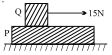
- 9$A$ long plank $P$ of the mass $5\, kg$ is placed on a smooth floor. On $P$ is placed a block $Q$ of mass $2\, kg$. The coefficient of friction between $P$ and $Q$ is $0.5$. If a horizontal force $15N$ is applied to $Q$, as shown, and you may take $g$ as $10N/kg.$View Solution
- 10A stone weighing $1$ kg and sliding on ice with a velocity of $2$ m/s is stopped by friction in $10$ sec. The force of friction (assuming it to be constant) will be ......... $N$View Solution