MCQ
The colligative properties of a solution depend on
- ✓The relative number of solute particles present in it
- BThe chemical nature of the solute particle present in it.
- CThe size of the container used
- DNone of these
The following four properties are colligative properties :
($i$) Lowering of vapour pressure of the solvent.
($ii$) Elevation in boiling point of the solvent.
($iii$) Depression in freezing point of solvent.
($iv$) Osmotic pressure.
Generate a complete, print-ready paper with questions like this in minutes — across 16+ boards, with answer keys.
Assertion $A$: Permanganate titrations are not performed in presence of hydrochloric acid.
Reason $R$ : Chlorine is formed as a consequence of oxidation of hydrochloric acid.
In the light of the above statements, choose the correct answer from the options given below.
$2NOB{r_{(g)\,}}\, \rightleftharpoons \,2N{O_{(g)}}\, + \,B{r_{2(g)}}$
if ${P_{B{r_2}}}$ is $\frac {P}{4}$ At equilibrium and $P$ is total pressure then calculate $\frac {P}{K_P}.$
which of the following alkyne cannot give ketone
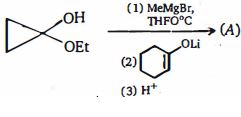
$H_3PO_3 \to H_3PO_4 + PH_3$