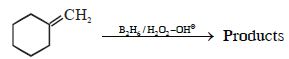
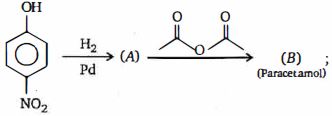
MCQ
The colligative properties of a solution depend on
- ✓The relative number of solute particles present in it
- BThe chemical nature of the solute particle present in it.
- CThe size of the container used
- DNone of these
The following four properties are colligative properties :
($i$) Lowering of vapour pressure of the solvent.
($ii$) Elevation in boiling point of the solvent.
($iii$) Depression in freezing point of solvent.
($iv$) Osmotic pressure.
Generate a complete, print-ready paper with questions like this in minutes — across 16+ boards, with answer keys.
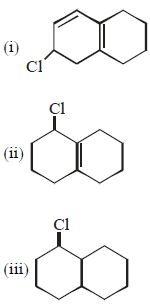
$\text{HO}−\text{CH}_2−\text{CH}−\text{CH}_2−\text{OH}\\ \ \ \ \ \ \ \ \ \ \ \ \ \ \ \ \ \ \ \ \ \ \ ∣ \\ \ \ \ \ \ \ \ \ \ \ \ \ \ \ \ \ \ \ \ \ \text{CH}_3$
$CH_3CH_2CH_2CONH_2$ $\mathop {\xrightarrow{{Ca{{(OH)}_2},C{l_2}}}}\limits_\Delta X\xrightarrow{{HN{O_2}}}Z$
$\mathop {\begin{array}{*{20}{c}}
{\begin{array}{*{20}{c}}
{COOH\,\,} \\
{|\,\,\,\,\,\,\,\,\,\,\,\,\,\,\,} \\
{H - C - OH\,\,\,\,\,\,\,\,\,\,\,} \\
{|\,\,\,\,\,\,\,\,\,\,\,\,\,\,\,}
\end{array}} \\
{Br - C - H\,\,\,\,\,\,\,\,\,\,\,\,\,\,\,\,\,} \\
{|\,\,\,\,\,\,\,\,\,\,\,\,\,\,\,\,\,} \\
{\,\,\,COOC{H_3}}
\end{array}}\limits_{(I)} $ $\mathop {\begin{array}{*{20}{c}}
{\begin{array}{*{20}{c}}
{\,\,\,\,\,\,\,\,COOC{H_3}\,\,} \\
{|\,\,\,\,\,\,\,\,\,\,\,\,\,\,\,} \\
{H - C - Br\,\,\,\,\,\,\,\,\,\,\,} \\
{|\,\,\,\,\,\,\,\,\,\,\,\,\,\,\,}
\end{array}} \\
{HO - C - H\,\,\,\,\,\,\,\,\,\,\,\,\,\,\,\,\,} \\
{\,\,|\,\,\,\,\,\,\,\,\,\,\,\,\,\,\,\,\,} \\
{\,\,\,\,\,\,\,COOH\,\,\,\,\,\,\,\,}
\end{array}}\limits_{(II)} $