MCQ
The component of $i + j$ along $j + k$ will be
  • A
    $\frac{{i + j}}{2}$
  • $\frac{{j + k}}{2}$
  • C
    $\frac{{k + i}}{2}$
  • D
    None of these

Answer

Correct option: B.
$\frac{{j + k}}{2}$
b
(b) $\left[ {(i + j)\,.\,\frac{{(j + k)}}{{\sqrt 2 }}} \right]\frac{{(j + k)}}{{\sqrt 2 }} = \frac{{(j + k)}}{2}.$

Need a full question paper?

Generate a complete, print-ready paper with questions like this in minutes — across 16+ boards, with answer keys.

Start Generating Free

Similar questions

Which of the below given is a vector quantity:
  1. 8kg
  2. 4 seconds
  3. 6 Newton
  4. 90cm3
If $\text{f}(\text{x})=(\cos\text{x}+\text{i}\sin\text{x})(\cos2\text{x}+\text{i}\sin2\text{x})(\cos3\text{x}+\text{i}\sin3\text{x})...(\cos\text{nx}+\text{i}\sin\text{nx})\ \text{and}\ \text{f}(1)=1, $ then f1 is equals to:
  1. $$$\frac{\text{n}(\text{n}+1)}{2}$
  2. $\Big\{\frac{\text{n}(\text{n}+1)}{2}\Big\}^2$
  3. $-\Big\{\frac{\text{n}(\text{n}+1)}{2}\Big\}^2$
  4. $\text{none of these}$
Find all the points of discontinuity of the function $f$ defined by

$f(x) = \left\{ {\begin{array}{*{20}{c}}
{x + 2,}&{if\,\,x\,\, < \,\,1}\\
{0,}&{if\,\,\,x = 1}\\
{x - 2,}&{if\,\,x\,\, > \,\,1}
\end{array}} \right.$
Forces $3\overrightarrow{\text{OA}},\ 5\overrightarrow{\text{OB}}$ act along OA and OB. If their resultant passes through C on AB, then,
  1. C is a mid-point of AB.
  2. C divides AB in the ratio 2 : 1
  3. 3AC = 5CB
  4. 2AC = 3CB
Evaluate: $\int \frac{\cos x}{\left(\cos \frac{x}{2}+\sin \frac{x}{2}\right)^3} d x$
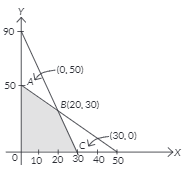
The maximum value of $Z=4 x+y$ for a L.P.P. whose feasible region is given below is:
Image
Solution of the equation $\left| {\,\begin{array}{*{20}{c}}1&1&x\\{p + 1}&{p + 1}&{p + x}\\3&{x + 1}&{x + 2}\end{array}\,} \right| = 0$ are
The value of the integral $\int_{0}^{\frac{\pi}{2}} 60 \frac{\sin (6 x)}{\sin x} d x$ is equal to.
The number of points, where the curve $f(x)=e^{8 x}-e^{6 x}-3 e^{4 x}-e^{2 x}+1, x \in R$ cuts $x$-axis, is equal to
If $\int {\sqrt 2 \sqrt {1 + \sin x} } \,\,dx = - \,4\cos (ax + b) + c$ then the value of $(a, b) $ is