MCQ
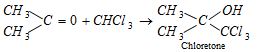
The compound $\begin{array}{*{20}{c}}
 \,\,\,\ \,\,\,\,\,\,\,\,\,{OH} \\ 
  \,\,\,\,\,\,\,\,| \\ 
  {{{(C{H_3})}_2}.CCC{l_3}} \\ 
  {} 
\end{array}$ is
  • Chloretone
  • B
    Chloroquin
  • C
    Chloropicrin
  • D
    Chloropropyl chloride

Answer

Correct option: A.
Chloretone
a
(a)

Need a full question paper?

Generate a complete, print-ready paper with questions like this in minutes — across 16+ boards, with answer keys.

Start Generating Free

Similar questions

Given the bond energies $N \equiv N,\,\,H - H$ and $N - H$ bonds are $945,\,436$ and $391\,kJ\,mol{e^{ - 1}}$ respectively, the enthalpy of the following reaction ${N_2}(g) + 3{H_2}(g) \to 2N{H_3}(g)$ is......$kJ$
Which of the following arrangements represents the increasing order ( smallest to largest) of ionic radii of the given species $O^{2-}, S^{2-}, N^{3-}, P^{3-}$ ?
The major product ($Y$) in the following reactions is

$\begin{array}{*{20}{c}}
  {C{H_3}\,\,\,\,\,\,\,\,\,} \\ 
  {|\,\,\,\,\,\,\,\,\,\,\,\,\,\,} \\ 
  {C{H_3} - CH - C = CH} 
\end{array}\xrightarrow[{{H_2}O}]{{HgS{O_4},{H_2}S{O_4}}}X$ $\xrightarrow[{(ii)\,conc.{H_2}S{O_4}/\Delta }]{{(i)\,{C_2}{H_5}MgBr,{H_2}O}}Y$

In Lassaigne’s test the organic compound is fused with $Na$ followed by extraction with distilled water. Which of the following is not the product of this fusion reaction
Consider the kinetic data given in the following table for the reaction $A + B + C \rightarrow$ Product.

Experiment No. $\begin{array}{c}{[ A ]} \\ \left( mol dm ^{-3}\right)\end{array}$ $\begin{array}{c}{[ B ]} \\ \left( mol dm ^{-3}\right)\end{array}$ $\begin{array}{c}{[ C]} \\ \left( mol dm ^{-3}\right)\end{array}$ Rate of reaction $\left( mol dm ^{-3} s ^{-1}\right)$
$1$ $0.2$ $0.1$ $0.1$ $6.0 \times 10^{-5}$
$2$ $0.2$ $0.2$ $0.1$ $6.0 \times 10^{-5}$
$3$ $0.2$ $0.1$ $0.2$ $1.2 \times 10^{-4}$
$4$ $0.3$ $0.1$ $0.1$ $9.0 \times 10^{-5}$

The rate of the reaction for $[ A ]=0.15 mol dm ^{-3},[ B ]=0.25 mol dm ^{-3}$ and $[ C ]=0.15 mol dm ^{-3}$ is found to be $Y \times 10^{-5} mol dm d ^{-3} s ^{-1}$. The value of $Y$ i. . . . . . .

Maximum solubility of alcohol in water is due to
Most reactive compound towards grignard's reagent
The major product of the following reaction is
The hydrolysis reaction that takes place at the slowest rate, among the following is
Which of the following is the best scientific method to test presence of water in a liquid