MCQ
The compound having both $sp$ and $s{p^2}$ hybridised carbon atom is
  • A
    Propene
  • B
    Propyne
  • Propadiene
  • D
    None of these

Answer

Correct option: C.
Propadiene
c
(c) $\mathop {\mathop {C{H_3}}\limits_{s{p^2}} = \mathop {{C_{}}}\limits_{sp} = \mathop {C{H_2}}\limits_{s{p^2}} }\limits_{{\rm{Propadiene}}} $

Propadiene has both $sp$ and $s{p^2}$-hybridized carbon atoms.

Need a full question paper?

Generate a complete, print-ready paper with questions like this in minutes — across 16+ boards, with answer keys.

Start Generating Free

Similar questions

Calcium imide on hydrolysis will give gas $(B)$ which on oxidation by bleaching powder given gas $(C)$. Gas $(C)$ on reaction with magnesium gives compound $(D)$. $(D)$ on hydrolysis gives again gas $(B), (B), (C)$ and $(D)$ are
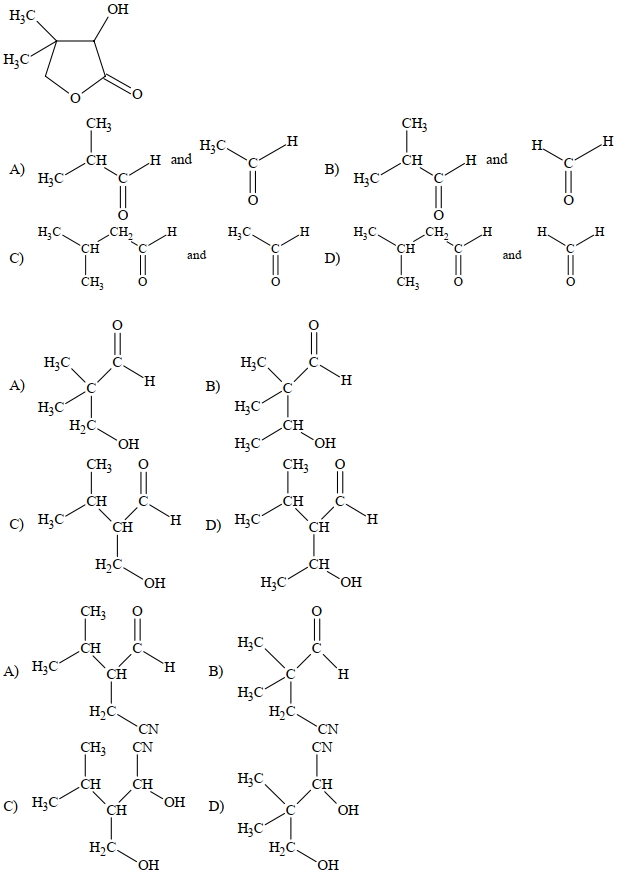
Two aliphatic aldehydes $\mathrm{P}$ and $\mathrm{Q}$ react in the presence of aqueous $\mathrm{K}_2 \mathrm{CO}_3$ to give compound $\mathrm{R}$, which upon treatment with $\mathrm{HCN}$ provides compound $\mathrm{S}$. On acidification and heating, $\mathrm{S}$ gives the product shown below: $Image$

$1.$ The compounds $\mathrm{P}$ and $\mathrm{Q}$ respectively are

MCQ $Image$

$2.$ The compound $R$ is

MCQ $Image$

$3.$ The compound $\mathrm{S}$ is

MCQ $Image$

Give the answer question $1,2$ and $3.$
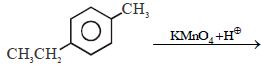
What is the major product of the following reaction ?
The species $Ar, K^+$ and $Ca^{2+}$ contain the same number of electrons. In which order do their radii increase ?
Which solution contains maximum number of ${H^ + }$ ion
Which one of the following salts gives an acidic solution in water
The molar heat capacity of water at constant pressure is $75\, JK^{-1}\, mol^{-1}$. When $1\,kJ$ of heat is supplied to $100\, g$ of water, which is free to expand, the increase in temperature of water is ............... $K$
The electronic configuration of fluorine is
In test of $NO_3\,^-$ ion, the dark brown ring complex is formed which is wrong of this complex ?
If compound $MX_4$ is non-polar without lone pair at central atom than bond angle $ <  XMX$ in compound may be