MCQ
The compound in which ${C^*}$ uses $s{p^3}$ hybrids for bond formation is
  • A
    $H\mathop C\limits^ + OOH$
  • B
    ${(N{H_2})_2}\mathop C\limits^ + O$
  • ${(N{H_3})_3}\mathop C\limits^ + OH$$HgC{l_2}$
  • D
    $C{H_3}\mathop C\limits^ + HO$

Answer

Correct option: C.
${(N{H_3})_3}\mathop C\limits^ + OH$$HgC{l_2}$
c
$\left( NH _3\right)_3 C^*OH HgCl _2$ in this molecule the $C ^*$ has to have all single bonds, therefore, it is $sp ^3$ hybridized.

Where as in $HC^*OOH,\left( NH _2\right)_2{ }C^*O$ and $CH _3 C^*HO$ in that all ${ }_{ C }^*$ having double bonds so the are showing $sp^2$ hybridization

Need a full question paper?

Generate a complete, print-ready paper with questions like this in minutes — across 16+ boards, with answer keys.

Start Generating Free

Similar questions

Given below are two statements :
Statement $I :$ Picric acid is $2, 4, 6-$trinitrotoluene.
Statement $II :$ Phenol$-2, 4-$disulphuric acid is treated with conc. $HNO_3$ to get picric acid. In the light of the above statement, choose the most appropriate answer from the options given below :
$(1) $ Statement $I$ is incorrect but Statement $II$ is correct.
$(2)$ Both Statement $I$ and Statement $II$ are incorrect.
$(3)$ Statement $I$ is correct but Statement $II$ is incorrect.
$(4)$ Both Statement $I$ and Statement $II$ are correct.
${{C}_{6}}{{H}_{5}}OH+ClCOC{{H}_{3}}\xrightarrow{\text{aq}\text{. }NaOH}{{C}_{6}}{{H}_{5}}OCOC{{H}_{3}}$  is an example of
Which of the following pair are not resonating structure ?
The pair of compounds having metals in their highest oxidation state is
Assertion : $NF_3$ is a weaker ligand than $N(CH_3)_3$.

Reason : $NF_3$ ionizes to give $F^-$ ions in aqueous solution.

$10\,g$ of $CaCO_3$ contains
Match List$-I$ with List$-II$ :

List$-I$ List$-II$
$A$ $H _3 O ^{+}$ $I$ Tetrahedral
$B$ Acetylide anion $II$ Linear
$C$ $NH _4^{+}$ $III$ Pyramidal
$D$ $ClO _2^{-}$ $IV$ Bent

Choose the correct answer from the options given below :
Which particle may be removed from a stable neutral atom with least energy change :
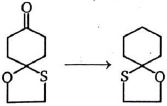
Above conversion can be achieved by
$C ( s )+ O _{2}( g ) \rightarrow CO _{2}( g )+400\; kJ$

$C ( s )+\frac{1}{2} O _{2}( g ) \rightarrow CO ( g )+100 \;kJ$

When coal of purity $60 \%$ is allowed to burn in presence of insufficient oxygen, $60 \%$ of carbon is converted into $'CO'$ and the remaining is converted into $'CO _{2}$$'$.

The heat generated when $0.6 \;kg$ of coal is burnt is