MCQ
The compound in which carbon uses only its $s{p^3}$ hybrid orbitals for bond formation is
  • A
    $HCOOH$
  • B
    ${(N{H_2})_2}CO$
  • ${(C{H_3})_3}COH$
  • D
    ${(C{H_3})_3}CHO$

Answer

Correct option: C.
${(C{H_3})_3}COH$
(c)$\mathop {C{H_3}}\limits^{s{p^3}}  - \mathop {{C^{s{p^3}}} - }\limits_{\mathop {|\,\,{\kern 1pt} \,\,\,{\kern 1pt} {\kern 1pt} {\kern 1pt} {\kern 1pt} {\kern 1pt} {\kern 1pt} {\kern 1pt} {\kern 1pt} {\kern 1pt} {\kern 1pt} {\kern 1pt} {\kern 1pt} }\limits_{\mathop {C{H_{3\,\,\,\,\,}}}\limits_{s{p^3}\,\,} {\mkern 1mu} {\mkern 1mu} {\mkern 1mu} {\mkern 1mu} {\mkern 1mu} {\mkern 1mu} {\mkern 1mu} {\mkern 1mu} {\mkern 1mu} {\mkern 1mu} } }^{\mathop {|{\kern 1pt} {\kern 1pt} \,\,{\kern 1pt} {\kern 1pt} \,\,{\kern 1pt} {\kern 1pt} {\kern 1pt} {\kern 1pt} {\kern 1pt} {\kern 1pt} {\kern 1pt} {\kern 1pt} {\kern 1pt} {\kern 1pt} }\limits^{\mathop {C{H_{3\,\,\,\,\,}}}\limits^{s{p^3}\,\,} {\mkern 1mu} {\mkern 1mu} {\mkern 1mu} {\mkern 1mu} {\mkern 1mu} {\mkern 1mu} {\mkern 1mu} {\mkern 1mu} {\mkern 1mu} {\mkern 1mu} {\mkern 1mu} {\mkern 1mu} } } OH$

All the carbon atoms are $s{p^3}$ hybridized.

Need a full question paper?

Generate a complete, print-ready paper with questions like this in minutes — across 16+ boards, with answer keys.

Start Generating Free

Similar questions

The number of $4 f$ electrons in the ground state electronic configuration of $\mathrm{Gd}^{2+}$ is ........ .

[Atomic number of $\mathrm{Gd}=64$ ]

It is recommended that liquid ammonia bottle should be opened after cooling it in ice for sometime. This is because liquor ammonia:
The end product of the reactions is

${{C}_{2}}{{H}_{5}}N{{H}_{2}} \xrightarrow{HN{{O}_{2}}}A \xrightarrow{PC{{l}_{5}}}B \xrightarrow{H.N{{H}_{2}}}C$

$\mathop {{C_3}{H_7}I}\limits_{(P)} \xrightarrow[{\left( {alco.} \right)}]{{KOH}}Q\xrightarrow{{NBS}}R\xrightarrow{{KCN}}C{H_2} = CH - C{H_2} - CN$,

$P$ can be

Among $\mathrm{CrO}, \mathrm{Cr}_2 \mathrm{O}_3$ and $\mathrm{CrO}_3$, the sum of spin-only magnetic moment values of basic and amphoteric oxides is . . . . . . . . $10^{-2} \mathrm{BM}$ (nearest integer).

(Given atomic number of $\mathrm{Cr}$ is 24 )

The rate of the reaction $2{N_2}{O_5} \to 4N{O_2} + {O_2}$ can be written in three ways

$\frac{{ - d\left[ {{N_2}{O_5}} \right]}}{{dt}} = k\left[ {{N_2}{O_5}} \right]$ , 

$\frac{{d\left[ {N{O_2}} \right]}}{{dt}} = k'\left[ {{N_2}{O_5}} \right]$,

$\frac{{d\left[ {{O_2}} \right]}}{{dt}} = k''\left[ {{N_2}{O_5}} \right]$

The relationship between $k$ and $k'$ and between $k$ and $k^{"}$ are
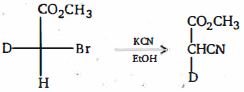
The configurations of the reactant and the product in the following reaction,  respectively, are:
Which of the following has maximum energy
Identify the incorrect statement among the following
Effective atomic number of iron in brown ring complex is