MCQ
The compound that is not olefinic organometallic is
  • $K\left[ {{C_2}{H_4}PtC{l_3}} \right].3{H_2}O$
  • B
    $Be{(C{H_2})_2}$
  • C
    ${({C_2}{H_4}PtC{l_3})_2}$
  • D
    ${C_4}{H_4}Fe{(CO)_3}$

Answer

Correct option: A.
$K\left[ {{C_2}{H_4}PtC{l_3}} \right].3{H_2}O$
a
It’s obvious.

Need a full question paper?

Generate a complete, print-ready paper with questions like this in minutes — across 16+ boards, with answer keys.
Start Generating Free

Similar questions

If the wave number of light is $5 \times 10^6 m^{-1}$, then the frequency associated with this light is __________ .
When $HgI_2$ is added to aqueous solution of $KI$, then the
Which of the following has maximum number of unpaired electron
Which one of the following has $\Delta {S^o}$ greater than zero
Which of the following order of acidic strength is correct ?
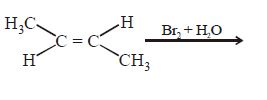
Major product of reaction is :
The $IUPAC$ name of neopentane is
The number of secondary hydrogens in $2, 2-$ dimethyl butane is
When $100 \ mL$ of $1.0 \ M \ HCl$ was mixed with $100 \ mL$ of $1.0 \ M \ NaOH$ in an insulated beaker at constant pressure, a temperature increase of $5.7^{\circ} C$ was measured for the beaker and its contents (Expt. $1$). Because the enthalpy of neutralization of a strong acid with a strong base is a constant $\left(-57.0 \ kJ \ mol ^{-1}\right)$, this experiment could be used to measure the calorimeter constant. In a second experiment (Expt. $2$), $100 \ mL$ of $2.0 \ M$ acetic acid $\left(K_a=2.0 \times 10^{-5}\right)$ was mixed with $100 \ mL$ of $1.0 M \ NaOH$ (under identical conditions to Expt. $1$) where a temperature rise of $5.6^{\circ} C$ was measured.

(Consider heat capacity of all solutions as $4.2 J g ^{-1} K ^{-1}$ and density of all solutions as $1.0 \ g mL ^{-1}$ )

$1.$ Enthalpy of dissociation (in $kJ mol ^{-1}$ ) of acetic acid obtained from the Expt. $2$ is

$(A)$ $1.0$ $(B)$ $10.0$ $(C)$ $24.5$ $(D)$ $51.4$

$2.$ The $pH$ of the solution after Expt. $2$ is

$(A)$ $2.8$ $(B)$ $4.7$ $(C)$ $5.0$ $(D)$ $7.0$

Give the answer question $1$ and $2.$
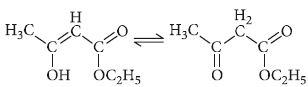
The enolic form of ethyl acetoacetate as shown below has