MCQ
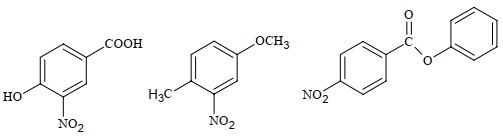
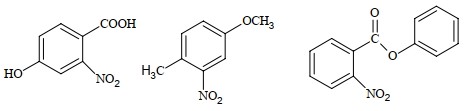
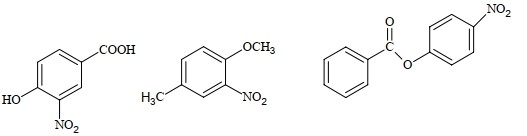
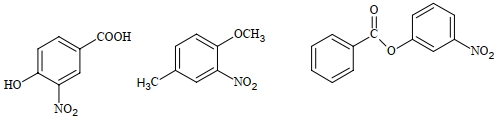
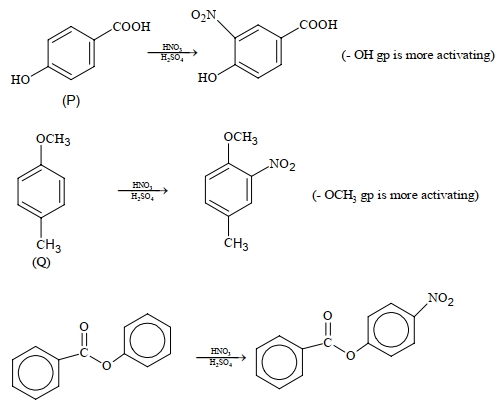
The compounds $\mathrm{P}, \mathrm{Q}$ and $\mathrm{S}$ $Image$ were separately subjected to nitration using $\mathrm{HNO}_3 / \mathrm{H}_2 \mathrm{SO}_4$ mixture. The major product formed in each case respectively, is
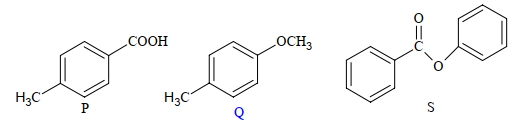
  • A

  • B


  • D

Answer

Correct option: C.

c

Need a full question paper?

Generate a complete, print-ready paper with questions like this in minutes — across 16+ boards, with answer keys.

Start Generating Free

Similar questions

Which of the following molecular geometry is not produced by $sp^3$ hybridisation
Red precipitate is obtained when ethanol solution of dimethylglyoxime is added to ammoniacal $Ni(II).$ Which of the following statements is not true?
Three complexes, $[CoCl(NH_3)_5]^{2+}\, (I)$, $[Co(NH_3)_5H_2O]^{3+}\, (II)$ and $[Co(NH_3)_6]^{3+}\, (III)$ Absorb light in the visible region. The correct order of the wavelength of light absorbed by them is
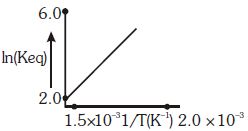
A schematic plot of $\ell n\, K_{eq}$ verses inverse oftemperature for a reaction is shown below. The reaction must be
Calculate $\Delta  H$ when $2\  moles$ of solid benzoic acid undergo complete combustion at $300\,K$ if $C_6H_5COOH_{(s)} + \frac{15}{2} O_2 (g) \rightarrow 7CO_2(g) + 3H_2O(l)$ $\Delta  U_{reaction} = - 750\  kJ/mole$ [$R = 8 \ Joule/ mole-K$] .........$kJ$
The standard potential of a $Co^{+2}| Co$  electrode is $-0.28\,V$  and the standard potential of the cell  $Pt|Ti^{2+} (aq),\, Ti^{3+} (aq)||Co^{2+} (aq)|Co(s)$ is $0.09\,\,V$.  What is the standard oxidation potential of the $Ti_{{\text{(aq}}.)}^{2 + }\,\,|\,\,Ti_{{\text{(aq}}.)}^{3 + }$ electrode ? ............. $\mathrm{V}$
A reaction that is of the first order with respect to reactant $A$ has a rate constant $6\,{\min ^{ - 1}}.$ If we start with $[A] = 0.5\,mol\,\,{l^{ - 1}}$, when would $[A]$ reach the value $ 0.05\,mol$ ${l^{ - 1}}$ ...... $\min$
Product $(A)$ of this reaction is
$250\,\, ml$ ,$6\,\,M$ $HCl$ and $350\,\, ml$, $8\,\,M$ $HNO_3$ are mixed with water to make the strengh of the resulting solution $3\,\,N$. What is the volume of water added ?................ $\mathrm{ml}$
Experimentally it was found that a metal oxide has formula $M _{0.98} O$. Metal M is present as $M ^{2+}$ and $M ^{3+}$ in its oxide. Fraction of the metal which exists as $M ^{3+}$ would be: